
Building TribeMarkets with AI: Architecture and Self-Fixing Production
Posted on:
I have been building TribeMarkets as a small but serious experiment: a private, play-money prediction-market platform where communities create Tribes, open markets, stake internal credits, and resolve outcomes.
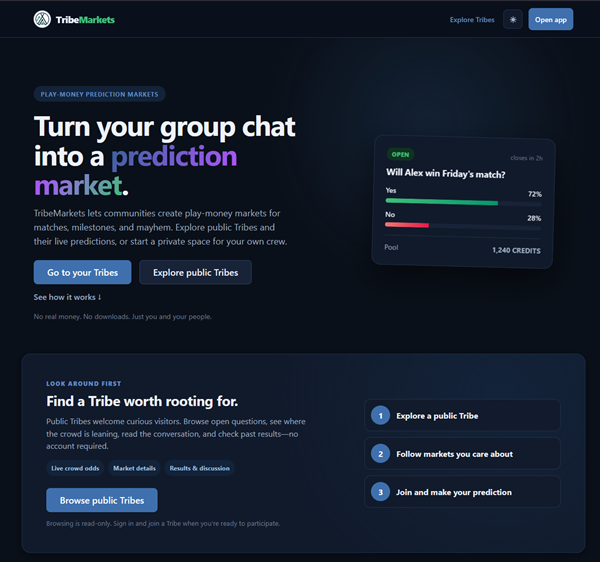
The interesting part is not only the product. It is the way the product is built. I am using AI throughout the software lifecycle, from planning and implementation to testing, code review, deployment, and production diagnosis. The goal is not to ask an AI to write a lot of code and hope for the best. The goal is to create a system in which fast code generation is surrounded by clear boundaries and increasingly automated verification.
The architecture: a modular monolith
TribeMarkets is intentionally a modular monolith. The backend is one FastAPI application backed by one PostgreSQL database. The frontend is a React and TypeScript single-page application served separately and communicating with the backend through a REST API.
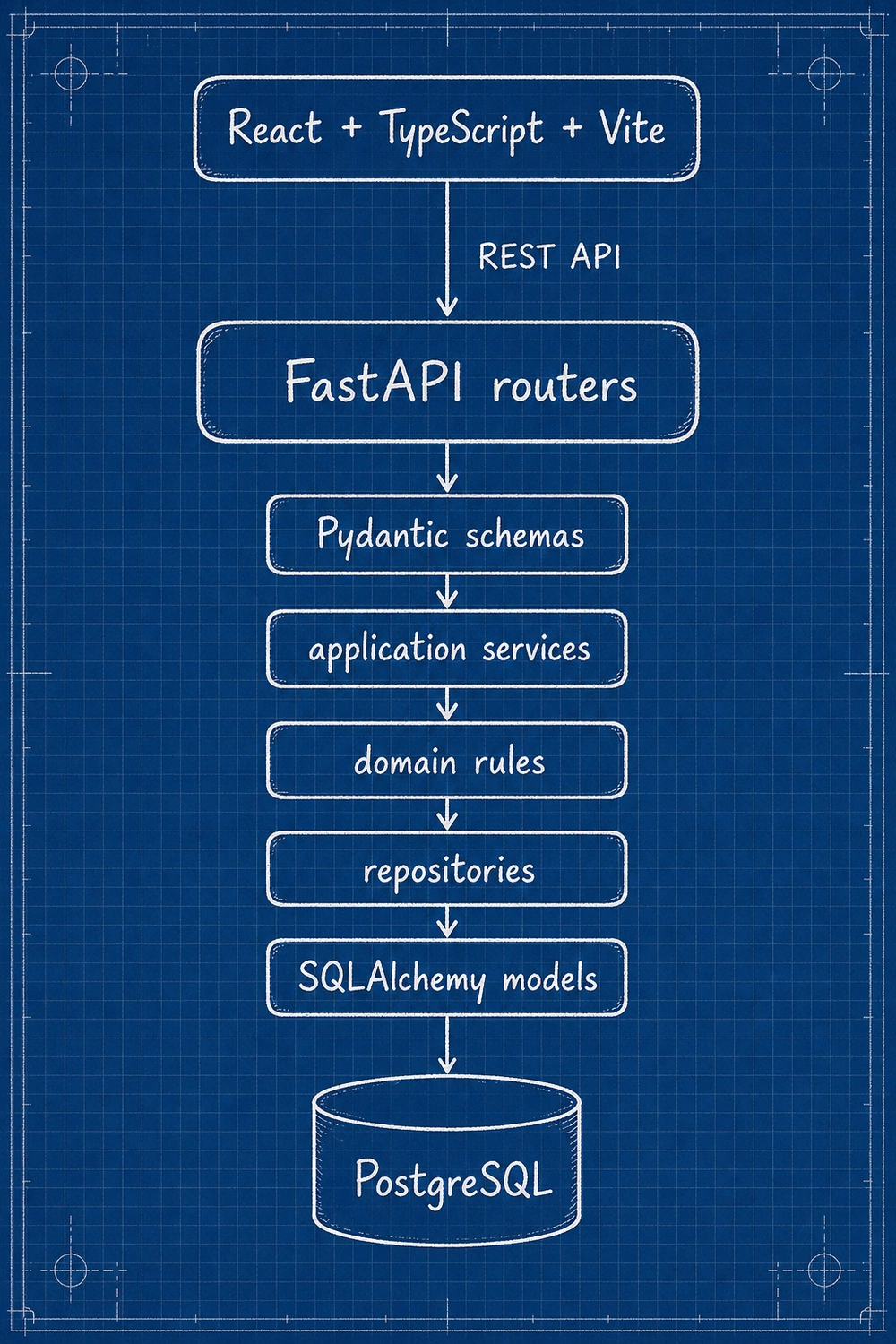
The modular part is important. Authentication, communities, currencies, wallets, the ledger, markets, settlements, notifications, and auditing are separate domain packages. The monolithic part is also important: there is no distributed transaction problem between the market engine and the ledger, and there are fewer moving pieces to deploy while the product is small.
Routes are deliberately thin. A route parses a request, invokes a service, and returns a response. The service owns authorization and the transaction boundary. Domain rules stay out of HTTP handlers, and repositories focus on persistence queries. This structure gives both humans and AI agents a map of where a change belongs.
Tenant isolation is a domain rule
The central product concept is the Tribe. Users can belong to multiple Tribes, and each Tribe has its own members, currency, markets, balances, permissions, notifications, and audit history.
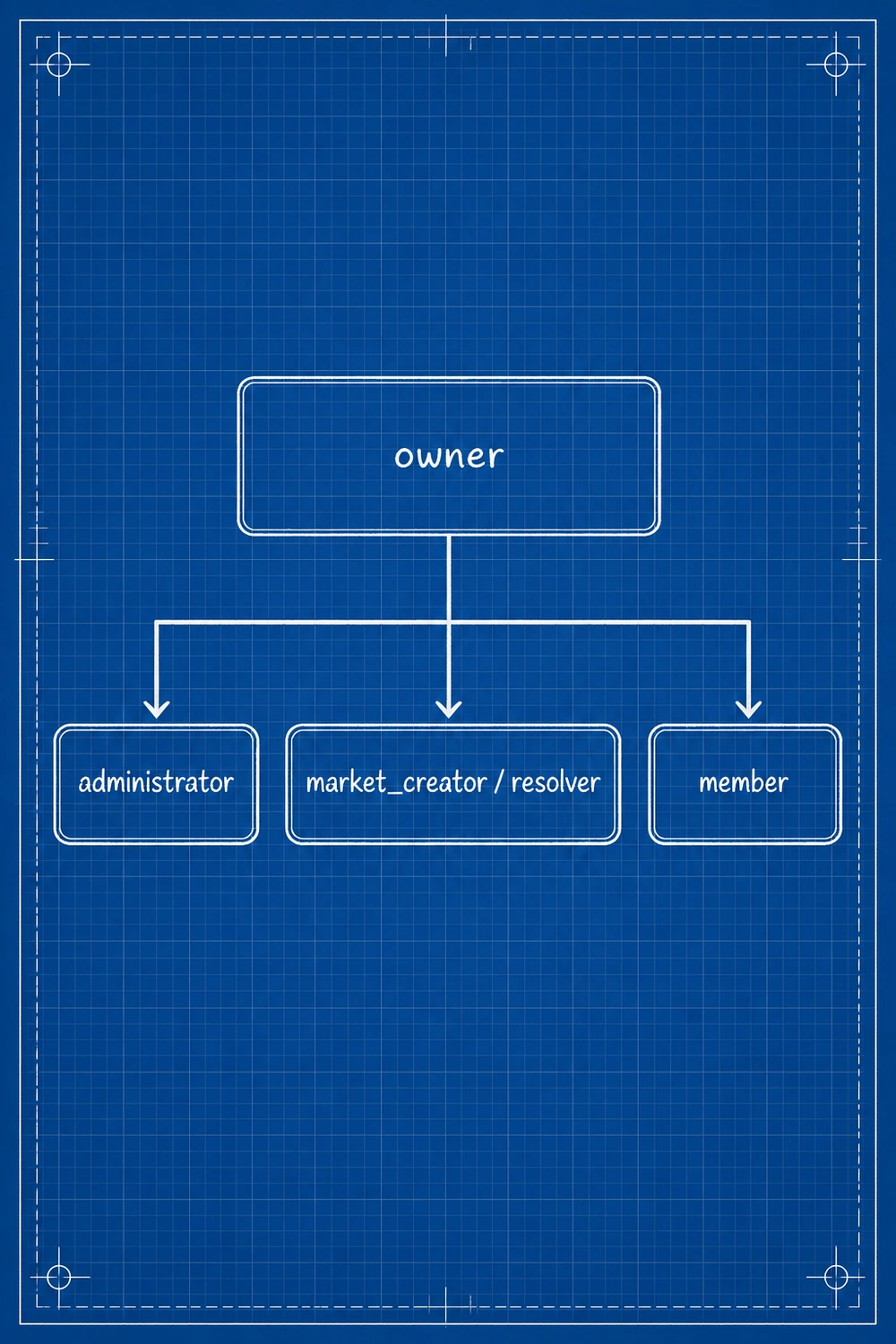
That means authorization cannot be implemented only by hiding buttons in the frontend. Every service operation re-checks the authenticated user, active membership, role, and Tribe scope. A non-member generally receives a not-found response for private Tribe resources so that the existence of private data is not leaked.
The role hierarchy is explicit:
The ledger is more important than the UI
TribeMarkets uses play-money credits, but the money rules still need to be correct. Balances are not stored as an authoritative number. They are derived from an immutable, double-entry ledger.
Every movement is a balanced transaction: a grant moves credits from a mint account to a user's available account, a stake moves credits into a reserved account, and settlement moves reserved credits back to winners. Ledger rows are append-only, and balance-changing operations use idempotency keys so a network retry does not accidentally spend twice.
Settlement math is pure and integer-exact. It works in the smallest currency units, applies deterministic largest-remainder rounding, and uses a stable position identifier as a tie-breaker. The total payout must equal the pool exactly.
This is a good example of where AI is useful but not authoritative. An AI can suggest settlement code or generate edge cases, but the invariants, tests, and database constraints define what is acceptable.
How AI is used to build the system
I treat the repository instructions as part of the development environment. They describe the layering rules, money invariants, authorization requirements, testing model, documentation obligations, and the difference between test types. An agent starts by discovering the relevant routes, schemas, services, repositories, models, migrations, frontend screens, and tests before changing anything.
The usual workflow is:
- Describe the behavior and acceptance criteria.
- Have an agent inspect every producer and consumer of that behavior.
- Implement the change through the layers instead of patching one screen.
- Add or update unit, integration, system, and end-to-end tests.
- Update the in-product help and developer documentation when behavior or APIs change.
- Run automated checks and review the resulting diff for security, tenancy, money, accessibility, and mobile regressions.
The test categories are intentionally distinct:
- Unit tests test an atomic function's inputs and outputs.
- Integration tests exercise collaborating code without mocking the calls between those functions.
- System tests exercise a higher-level application workflow, often against the real PostgreSQL test database, without requiring a real browser.
- End-to-end tests use Playwright to exercise what a user sees and does in the browser.
AI makes it inexpensive to create tests, but quantity is not the same as coverage. The valuable part is connecting each test to an invariant or a user journey: cross-Tribe isolation, exact decimal handling, role permissions, voided-market refunds, OAuth account linking, notification routing, and mobile layout behavior.
The production feedback loop
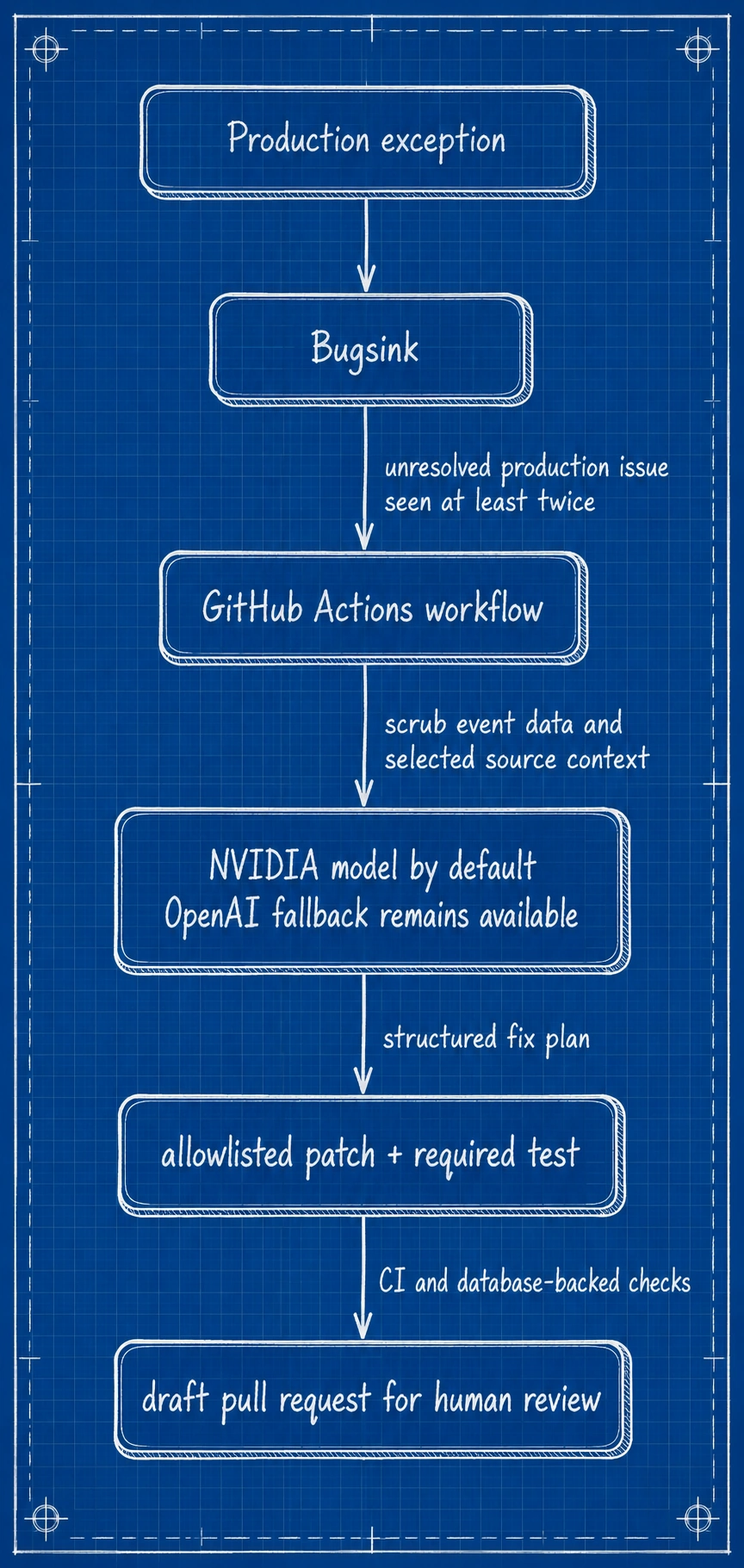
Production errors are sent to a self-hosted Bugsink instance. Backend unhandled exceptions and frontend error-boundary failures become grouped issues. Bugsink is not a general-purpose stream of every application log, and ordinary request logs are not sent to an AI model.
The repository contains a scheduled GitHub Actions workflow that runs every fifteen minutes. Its job is not to silently edit production. Its job is to prepare a guarded draft pull request when there is enough evidence that a repeatable production issue may have a low-risk code fix.
What the auto-fix workflow actually does
The workflow has several layers of defense.
First, it filters candidates. The issue must be unresolved, associated with a production environment, and have at least two occurrences. Security, infrastructure, and uncertain classifications are not automatically turned into patches.
Second, the issue and source context are scrubbed and size-bounded before they are sent to the model. Common credentials, bearer tokens, URI passwords, emails, and secret query parameters are redacted. Only selected source files from allowlisted directories are considered.
Third, the model must return a structured plan containing a classification, confidence, summary, root cause, patch, changed files, tests, risk flags, and an explicit decision about whether a pull request is appropriate. The current workflow requires a confidence of at least 0.85 and rejects plans with risk flags or mismatched changed-file declarations.
Fourth, the patch is constrained. It may touch only existing application, frontend, script, or test files. It cannot create or delete files, modify the auto-fix machinery itself, or change arbitrary infrastructure. Every automatic fix must add or update at least one test.
Finally, the patch is tested before a pull request is opened. The checks include
the repository harness, Python linting and strict typing, unit tests,
integration tests against a freshly migrated PostgreSQL database, and
git diff --check. Frontend changes additionally run TypeScript typechecking,
ESLint, the production build, and the frontend test suite.
The workflow has a stable issue/fingerprint/release key. That prevents the same production problem from opening a new pull request on every scheduled run. It is also limited to one pull request per run and three automation pull requests in a rolling twenty-four-hour period.
Why the pull request remains a draft
Calling this a self-fixing system is useful shorthand, but it is not an autonomous production mutation system. The model can misunderstand a stack trace, make a plausible but incomplete change, or write a test that confirms the wrong behavior. A passing test suite is evidence, not proof.
The workflow therefore creates a draft pull request and never merges or deploys. A human reviews the root cause, patch, tests, security implications, and product behavior. If the automation behaves unexpectedly, the GitHub Actions workflow can be disabled immediately, and the daily and per-run limits provide additional containment.
This separation is important: AI can reduce the time between an error and a reviewable proposal without being granted production credentials or merge authority.
Deployment
Deployment relies on Railway which contains many services that used Codex and the Railway CLI for the initial configuration. The ease to get started and then to deploy worth the cost. Having AI with the Railway CLI is a breeze and while it performs infrastructure changes, debugs and tweaking, I can focus on features.
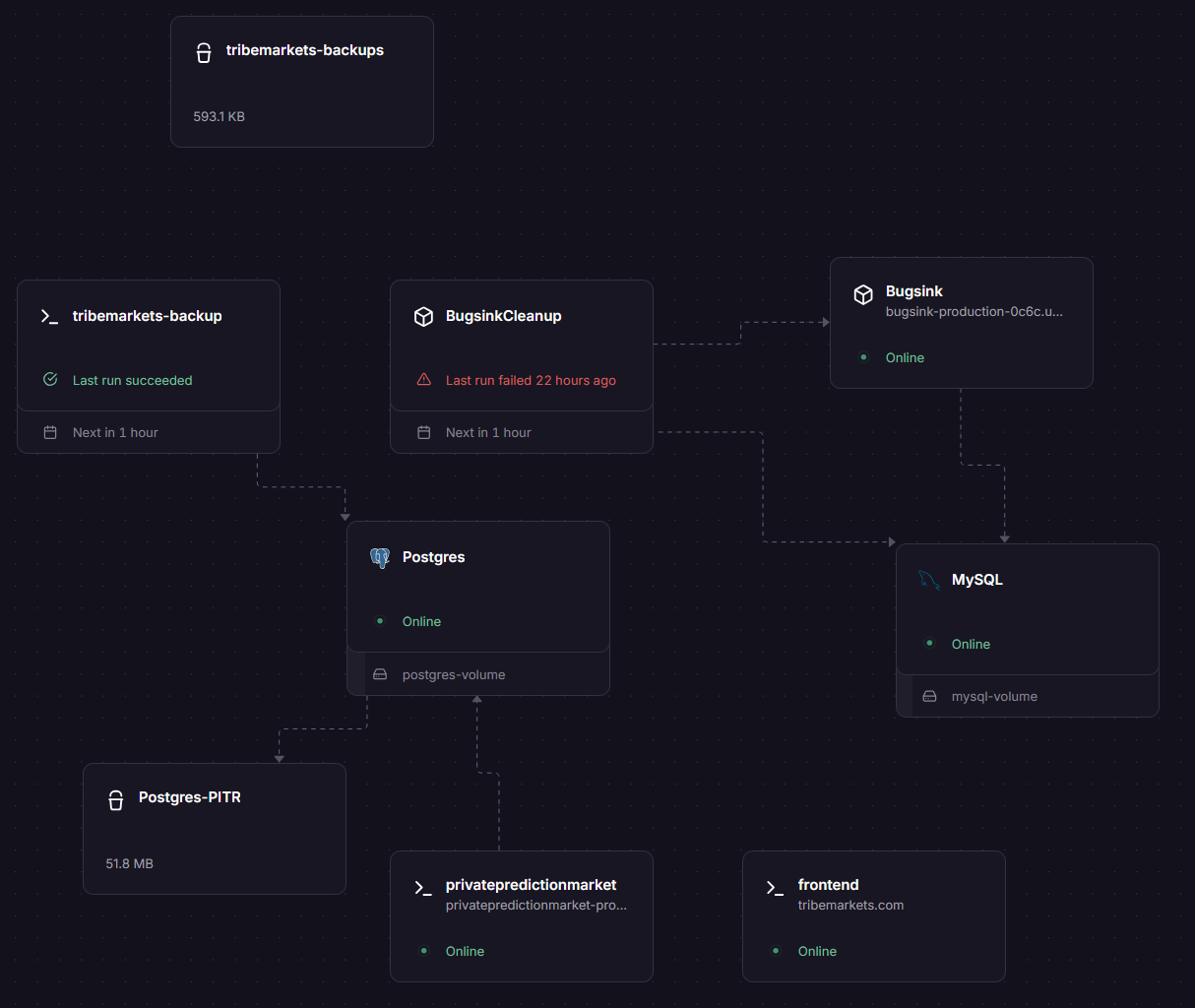
Above this text is the image of the configuration of the backend, frontend, database and also the bug tracker used to automatically fix bugs in production.
The practical lesson
The biggest benefit of AI has not been generating individual functions faster. It has been making it practical to work on the entire engineering loop at once: architecture, implementation, tests, documentation, observability, and repair.
That speed only works when the system has strong boundaries. A modular architecture gives agents a place to put changes. Domain invariants prevent convenient shortcuts from corrupting money or permissions. Layered tests catch different classes of mistakes. GitHub Actions and Bugsink close the loop after deployment.
The result is not software that fixes itself perfectly. It is a development system that can notice recurring failures, prepare a constrained proposal, and bring the problem back into the same tested review process that produced the original software.
Discussion
Replies are loaded from the public Mastodon thread for this article.
Loading replies from Mastodon...