
Teaching a small local model to speak typescript
Posted on:
Teaching a small model a big model's good habits
I am experimenting with an idea called oktopai: instead of asking one small local model to know every programming language and framework, can I keep several focused specialists and load the right one when it is needed?
The first specialist is TypeScript. The goal is not simply to make a model sound as if it knows TypeScript. The goal is for it to produce code that a real TypeScript compiler accepts, while remaining fast and private on a local GPU.
The teacher and the student
Imagine a junior programmer learning from a very experienced programmer. The experienced programmer solves many problems and explains the solutions. The junior programmer studies those examples and gradually learns useful patterns.
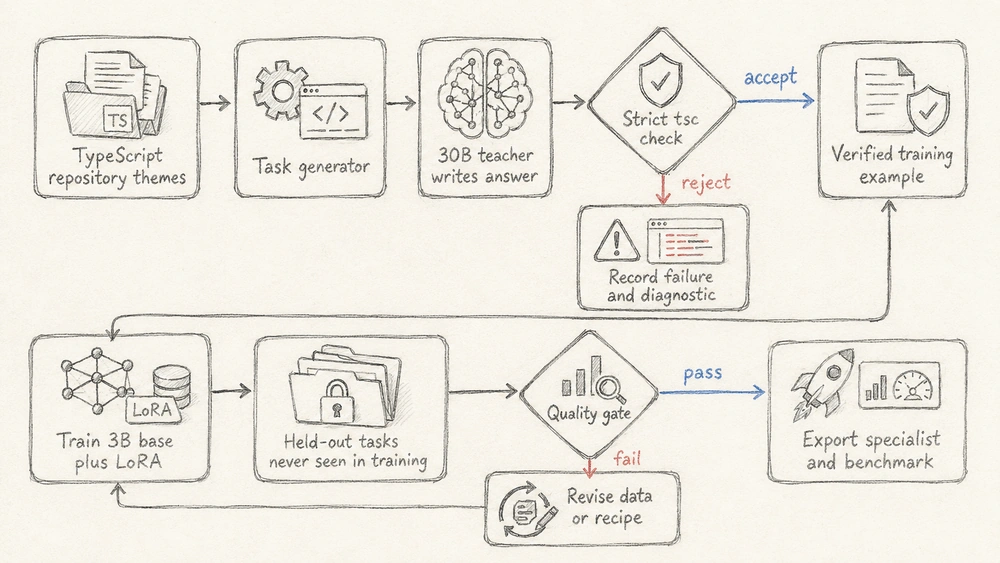
That is the teacher–student process:
strong teacher model
        ↓ writes an answer
TypeScript compiler and tests
        ↓ reject incorrect answers
verified examples
        ↓ teach
small student model
The teacher is Qwen3-Coder 30B in this experiment. The student is a much
smaller Qwen2.5-Coder 3B model. The teacher does not directly become the
student. It creates examples, and the student learns from them.
This matters because a small model has less room for general knowledge. I am trying to spend more of that limited capacity on decisions that matter for TypeScript: generics, narrowing, discriminated unions, async code, module boundaries, compiler errors, and safe refactoring.
Neural-network ?
Training happens in repeated steps. In one step, the student reads a small batch of examples, predicts the next tokens, compares its prediction with the teacher's answer, and calculates an error. Backpropagation then makes a tiny adjustment to the trainable weights.
It is like practising a musical passage. One practice attempt does not make a musician perfect. The model revisits examples over several passes, adjusting itself each time. Twelve thousand steps therefore means twelve thousand small learning updates; it does not mean twelve thousand unique TypeScript questions.
For this run, the base model is kept unchanged and a LoRA adapter stores the specialization. LoRA means "Low-Rank Adaptation" and it leaves all the existing weights frozen and trains a small number of extra ones instead. The student's original knowledge stays intact, and the new weights only change how it responds. Because that extra part is small, training uses less memory and finishes faster, and the output is an adapter file of a few megabytes instead of a multi-gigabyte model. This is similar to adding a replaceable TypeScript training module to the student's existing knowledge. If the adapter proves useful, it can later be merged into a standalone model and quantized for fast Ollama inference. By the way, Ollama is a free tool that runs language models on your own machine, so the model answers locally without sending anything to a cloud service.
Am I removing the model's useless knowledge?
No. LoRA training does not reach inside the base model and erase its knowledge of Python, history, or anything else. The base model remains frozen, and the TypeScript adapter adds a learned bias: for this kind of request, prefer these TypeScript patterns, explanations, and formats.
Instead of trying to cut knowledge out, I start from a small student model so it never carries much unnecessary knowledge in the first place. A 3B model has a limited budget, and picking a compact base keeps that budget from being spent on things the TypeScript specialist does not need.
Think of the base model, the one of the student, as a general-purpose toolbox. I am not throwing away the screwdrivers to make room for TypeScript tools. I am adding a labelled drawer and teaching the model which tools to reach for first. When the adapter is removed, the original toolbox is still there.
This can make the specialist behave as if irrelevant knowledge has been silenced, but it has not truly been deleted. A merged or fully fine-tuned model may change some existing behaviour, and an aggressive training run can cause forgetting, but neither is a reliable way to remove a specific piece of knowledge on purpose. The practical goal is narrower and safer: improve TypeScript performance while watching for regressions on general coding tasks.
The hot-swapping design relies on this. I can keep one base model loaded and attach or swap small adapters, or use separate merged specialists when that gives better speed. The router chooses the right expertise; it does not pretend that every other skill has disappeared.
What did not work well at first
The first versions looked promising on paper but produced weak models. There were several reasons.
Some examples came from compiler fixtures whose purpose was to test whether TypeScript rejects code. Those files are valuable to the TypeScript project, but they are not always good demonstrations of code a coding assistant should write. A model trained on them can learn the wrong lesson: reproduce a test artifact instead of solving the user's problem.
The initial local teacher also produced many answers that looked plausible but
did not compile. I measured this instead of assuming that fluent text was
useful. The early repository corpus passed only 71 of 2,450 strict compilation
checks. A later prompt improved that to 503, but it was still not good enough
to train on.
Finally, a low training loss is not the same as a good coding model. The student can memorize the shape of training answers while still failing new problems. Speed is not quality either: a model that answers at 250 tokens per second but writes invalid code is not a successful specialist.
Those runs were kept as measurements, but they were not promoted as useful models.
Generating better examples
I changed the data-generation contract. Instead of asking the teacher to write a loose explanation, each task asks for a standalone TypeScript answer with a precise purpose. The generated code is isolated in a temporary file and compiled with strict TypeScript settings.
Only accepted examples enter the student dataset. I also label task families so that the corpus is not just thousands of variations of one easy pattern. The current verified corpus covers six families, including type errors, generics, narrowing, asynchronous code, modules, and practical refactoring.
The stronger teacher generated 2,450 answers, and all 2,450 passed the strict compiler gate. That is a much more meaningful starting point than merely having 2,450 lines of generated text.
What does one generated task look like?
The source tasks were mined from the public TypeScript repository and grouped into useful families. The repository gave me realistic themes and APIs; the teacher turned each theme into a standalone coding exercise. For example, a task might ask for a generic function that preserves the type of the selected property:
{
  "family": "generics",
  "prompt": "Write a strict TypeScript function pick<T, K extends keyof T>(object, key) that returns object[key]. Include a usage example whose inferred type is string.",
  "answer": "function pick<T, K extends keyof T>(object: T, key: K): T[K] {\n  return object[key];\n}\n\nconst user = { name: 'Mina', age: 32 };\nconst name: string = pick(user, 'name');"
}
The answer is not accepted because it looks nice. Oktopai writes the code to an isolated file and runs the strict TypeScript compiler. The compiler checks that the generic constraint, indexed access, and usage example really agree. Rejected answers and compiler diagnostics are retained as experiment data, but are not silently mixed into the positive student-training set.
The pipeline can be pictured like this:
Should I generate more than 2,450 tasks?
Probably yes, but simply making the number larger is not enough. Two thousand near-duplicates can be less useful than a few hundred carefully balanced examples. More data becomes valuable when it adds new concepts, realistic repository context, difficult counterexamples, different coding styles, and tests that catch subtle type errors.
The current 2,450 examples are a strong verification milestone, not a claim that TypeScript has been completely covered. Before the next major training run, I should expand the corpus in controlled batches, deduplicate it, keep families balanced, and reserve a fixed untouched evaluation set. I should also add multi-file repairs, compiler-diagnostic-to-fix tasks, JavaScript to TypeScript migrations, declaration files, configuration files, and tests that exercise runtime behaviour as well as type checking.
New data has to earn its cost. I should measure whether a new batch improves the held-out score and family coverage. If 10,000 more examples do not improve those measurements, generating 100,000 would mostly make training slower and overfitting easier.
How can I make it fast and keep many specialists?
There are two different speeds to improve. Training speed is how quickly the student learns during the experiment. Inference speed is how quickly oktopai answers a developer. The long-term product goal is mostly about inference: fast, useful answers from a model that fits comfortably in local GPU memory.
The main strategy is to keep the expensive general knowledge shared and make the specialist knowledge small:
- Start with a compact base model, such as 3B parameters, instead of copying a large teacher into every specialist.
- Train a small LoRA adapter for TypeScript, CSS, SQL, or Next.js. Several adapters can share one base model, so the GPU does not need a complete copy of each model.
- Merge an adapter into a standalone model only when that improves serving speed or compatibility. Merging is a packaging choice, not extra knowledge.
- Quantize the served model to formats such as 4-bit or 8-bit. This reduces memory and often increases token throughput, with a possible quality cost that must be measured.
- Keep the active model on the GPU. Loading from disk for every request would make a fast model feel slow, so oktopai tracks warm models and uses an LRU policy when VRAM is full.
- Keep conversation state outside the model. Shorter, carefully selected context means fewer prompt tokens and faster responses.
- Use GPU-optimized local runtimes, continuous batching when there are several requests, and later investigate speculative decoding with a small draft model.
The target is not the highest possible tokens per second on its own. A tiny model can be extremely fast and still give poor answers. I will record tokens per second, time to first token, total latency, compiler acceptance, and held-out task quality together as the experiment goes on.
What does loading many models really mean?
Suppose a graphics card has 16 GB of VRAM. Two quantized 3B models might fit at the same time, depending on their context caches and runtime overhead. Ten models probably will not. Oktopai therefore treats models as a working set:
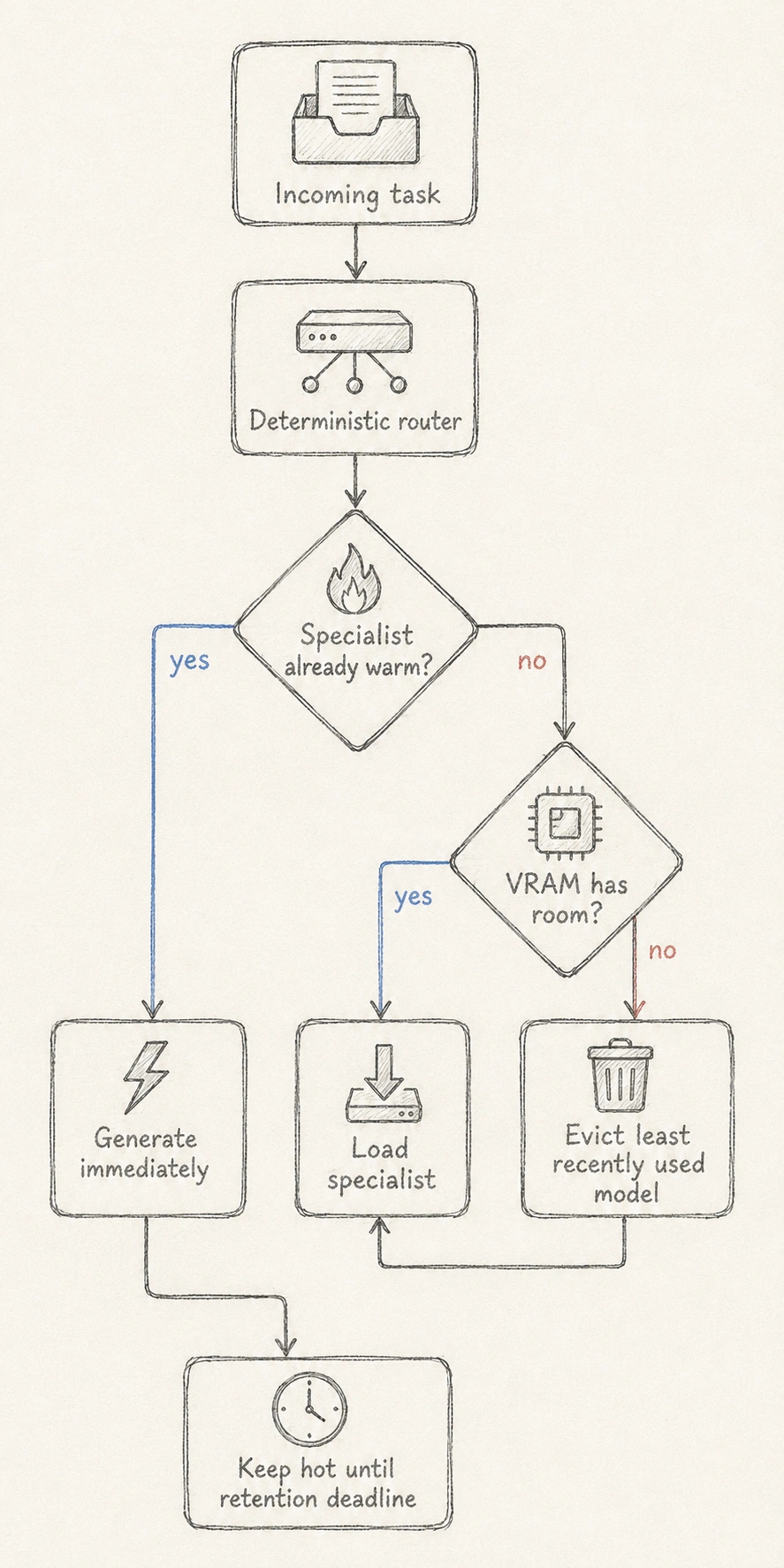
A model that is not currently needed can remain as weights on disk, in the operating-system file cache, or in system RAM. That is not the same as keeping it active on the GPU. When a new specialist is needed, loading it incurs a cold-start cost. If two logical experts share the same base model, only their small adapters or prompt configuration need to change, avoiding a complete model reload.
The best arrangement will depend on the machine and the workload. One merged 3B TypeScript model may give the best single-request throughput. A shared base plus several adapters may allow more expertise to stay available. Two smaller models may run concurrently, while a larger specialist may need exclusive GPU access. The lifecycle benchmark will measure these alternatives instead of assuming that more models loaded is automatically faster.
My planned speed experiments are therefore incremental: first establish a quality baseline, then compare FP16, 8-bit, and 4-bit serving; warm versus cold starts; one model versus shared-base adapters; and sequential versus parallel requests. A configuration only makes the final local fleet if it keeps the TypeScript answers good.
What happens now
The 3B student is being trained on those verified answers using CUDA (locally on my 5080 RTX). During training, checkpoints are saved so that progress is recoverable. When the run finishes, the student will face a separate held-out suite that it has never seen.
The decision process is deliberately strict:
- compare the student with the original 3B model
- compile both answers and measure task acceptance
- inspect family-by-family coverage
- record generation speed and time to first output
- promote the adapter only if correctness improves without an unacceptable regression elsewhere
If the student fails this test, the result is still useful. It tells me that the data, task design, training recipe, or model size needs work. I will not call a model specialized merely because it completed a long training run.
Why this connects to hot-swapping
The final vision is a local team of small experts. Oktopai can route a request to the TypeScript specialist, a CSS specialist, a Next.js specialist, or a database specialist. The active model is loaded into GPU memory while it is needed; another model can be unloaded or left in system storage.
The common conversation and repository context stay outside the model, so a switch does not erase the session. The GPU becomes a workspace for the current expert rather than a permanent home for every expert I may want.
That is the experiment: can several genuinely useful, narrowly trained local models outperform one mediocre general-purpose local model for their own tasks, while remaining fast enough to use interactively?
I am still testing the hypothesis. The compiler gates, held-out evaluations, raw outputs, timings, and failed experiments are all part of the answer.
Discussion
Replies are loaded from the public Mastodon thread for this article.
Loading replies from Mastodon...