
The Consequences of Easy Access to AI
Posted on:
The Dunning–Kruger effect occurs when individuals with limited knowledge in a domain believe that they have suddenly become experts in it. With easy access to AI tools, the Dunning–Kruger effect appears stronger than ever.
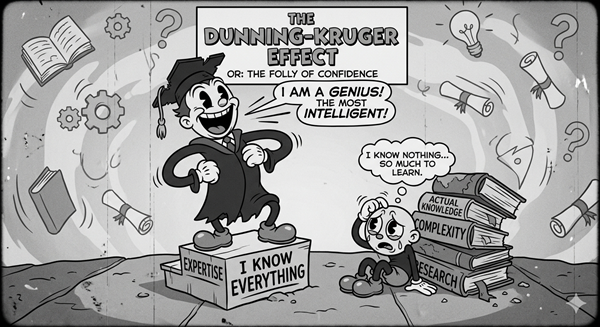
Software engineering has always had areas, such as user interface design, where many people felt comfortable offering opinions. These opinions could occasionally be helpful, but they also diluted the expertise of specialists in accessibility, design, and usability. Today, with AI assistance widely available, the phenomenon has intensified and become far more chaotic.
People with or without a software background can now quickly position themselves as experts by producing a stream of AI-generated solutions. The issue is that the consequences, trade-offs, scalability concerns, and other critical considerations such as security and performance are often absent from the discussion. Easy access to AI resembles access to a powerful tool. Like any power tool, it remains most effective and safest in the hands of people who understand the craft. Alongside the growing number of pseudo "vibe-coding" solutions, AI has also entered nearly every meeting. Participants query language models in real time with carefully crafted prompts that are often biased toward validating their own point of view. Discussions can quickly turn into a contest of AI-generated arguments delivered through human voices. This same ease of generation also produces lengthy technical or project documents that may take less than an hour to create but require many hours of human effort to review and validate.
One consequence is a shift in focus across organizations as many roles experiment with the new capabilities that AI offers. Leaders may spend time exploring new technical possibilities, project managers may create quick proof-of-concepts to better understand ideas, and engineers may experiment with rapid prototypes. While this exploration can be healthy, it can also blur responsibilities if it replaces the core work that keeps projects moving forward. The ease of building quick demonstrations sometimes encourages experimentation at the expense of the slower and less visible work of delivering, maintaining, and improving production systems.
AI may indeed offer genuine productivity gains, but it can also introduce a countervailing effect. The technology can amplify distraction, encourage superficial confidence in complex domains, and reinforce the Dunning–Kruger dynamic. The result can be inflated expectations around delivery while underestimating maintainability, operational complexity, and the long-term consequences of the systems being created.