Council of the Owls
Posted on:
There was once a kingdom deep in the forest called Oakridge, where animals of all kinds worked together to gather food, build shelters, and prepare for the long winters.
At the center of Oakridge stood the Great Tree, where the Council of Owls made all important decisions. The owls were known for their wisdom, but also for their love of structure, rituals, and very long meetings. One day, a young fox named Ember arrived at the edge of the forest. Ember was clever, quick, and deeply attentive. She noticed small things others ignored: a loose plank in a beaver dam, a pattern in where berries grew sweeter, inefficiencies in how squirrels stored nuts. She had ideas constantly, and she shared them freely. She listened, adjusted, refined. Before even joining, she was already thinking about how to improve the forest. But before she could enter, she had to pass the Trials of Entry.
For hours, Ember sat before different animals. A squirrel asked her how she would gather nuts efficiently. A beaver questioned her on dam construction theory. A hawk tested her awareness with hypothetical dangers from the sky. Finally, the owls themselves asked Ember to explain, in detail, how she would survive winter if everything went wrong. The trials lasted all day.
By sunset, the Council of Owls gathered. “This fox,” said one owl, adjusting his feathers, “has demonstrated sufficient capability.” Another nodded. “Yes. She meets the bar.” And just like that, after a few hours, Ember was welcomed into Oakridge as a Forager Level Two.
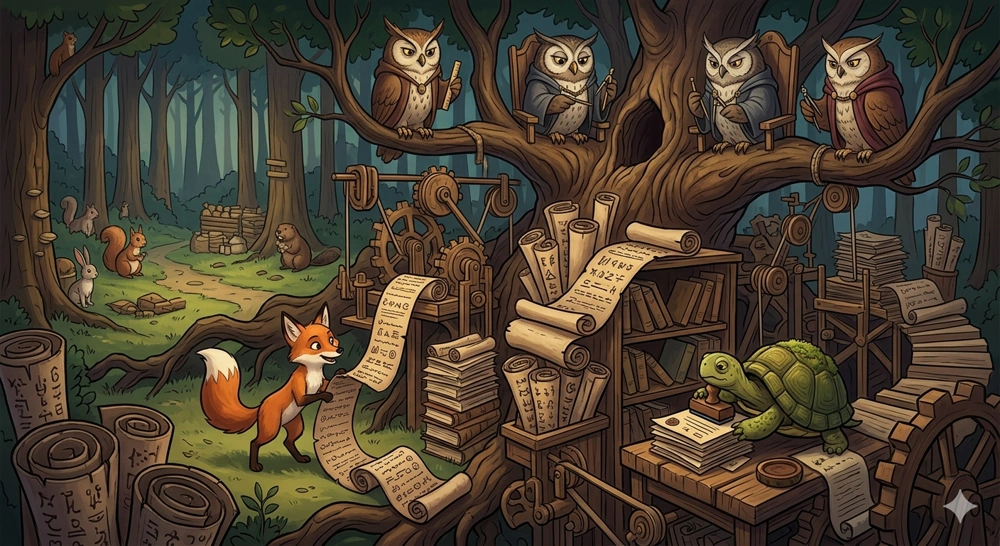
Ember wasted no time.
She went above and beyond in every corner of the forest. She mapped faster routes for gathering food and shared them with the rabbits. She redesigned storage layouts for the squirrels so fewer nuts spoiled. She worked with the beavers to reinforce dams before storms arrived. She paid attention to details others overlooked, catching small issues before they became problems. She was constantly active. Helping. Communicating. Suggesting improvements. Writing down better processes on bark so others could follow. When something failed, she investigated why. When something worked, she scaled it. Her work did not stay local. It spread.
Weeks turned into months. Ember’s impact became visible everywhere. Surely, she thought, the Council would recognize this. So one morning, Ember approached the Great Tree. “I would like to be considered for a higher role,” she said. “I have contributed consistently, improved systems, and helped others succeed.” The owls listened carefully. “Yes,” said one. “We have seen your work.” “Indeed,” said another. “Your performance is strong.” “But,” said the oldest owl, “promotion is a process.” And so began the Trials of Advancement.
Ember documented everything. She gathered feedback from rabbits, squirrels, beavers, and even hawks. She detailed her improvements, her ideas, her outcomes. The bark sheets grew thick with evidence.
The owls reviewed them. And then, they began to search. “This improvement is good,” said one owl, “but here,this part could have been communicated earlier.” Another pointed to a different section. “Yes, and in this case, the impact is clear, but the formal alignment with existing structures is less defined.” A third owl leaned in. “And this initiative, while successful, was not previously requested.” Each time Ember presented strong evidence, the owls found a thread to pull. They did not deny her contributions. They reframed them. Strong work became “inconsistent in scope.” Clear impact became “insufficiently formalized.” Proactive ideas became “outside defined expectations.”
Ember adjusted. She improved her communication. She aligned her work more explicitly. She documented even more carefully. She anticipated objections before they were raised.
Still, the owls continued. “There are comparisons to make,” said one. “We must evaluate against historical cases,” said another. “We must ensure no detail is overlooked,” added a third.
At one point, Ember gently asked, “Given all the work I have done, is there not enough evidence already?”
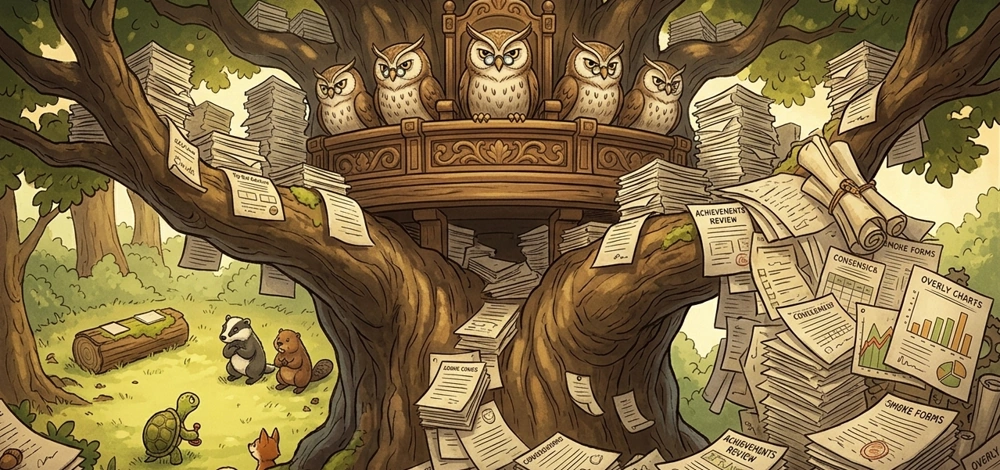
The owls exchanged looks. “The system must be thorough,” said the oldest owl. “But the system judged me in a single day when I joined,” Ember replied. “Now you have months of detailed work.” The owls nodded. “Yes,” said one, “but now we must be certain.” “And certainty,” added another, “requires examination of every angle.”
So they continued to examine. A turtle was assigned to validate her records. A committee of birds debated edge cases. New bark sheets were created to track alignment, consistency, and scope. Each step added clarity, but also delay.
Meanwhile, Ember did not slow down. She continued improving systems. Helping others. Catching subtle issues. Sharing ideas. Leading quietly without the title. Her work expanded across the forest, touching areas far beyond her original role.
And still, the process continued. Eventually, after many seasons, Ember was promoted. The announcement was formal. The documentation was complete. The tables were updated. Every concern had been addressed, every edge case reviewed, every possible flaw examined.
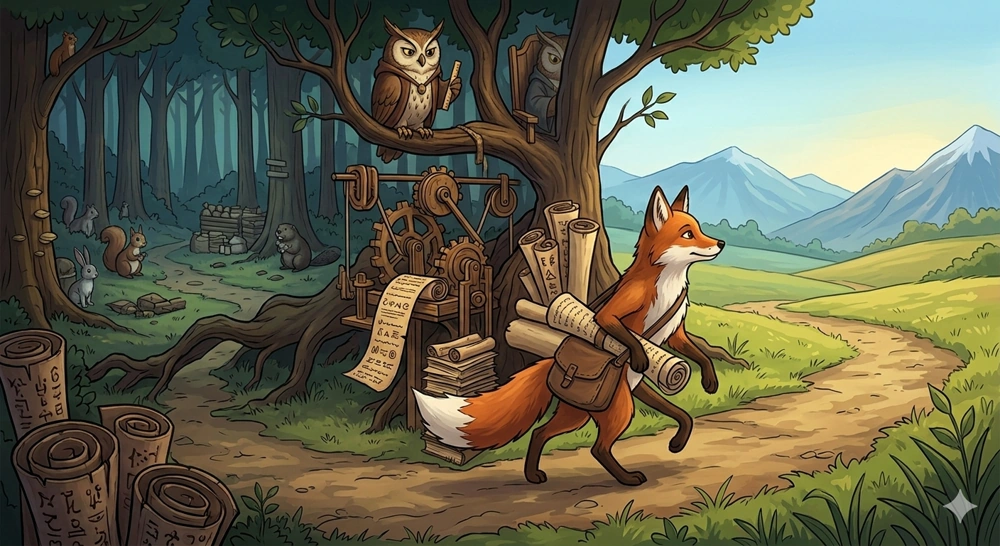
And the forest carried on. But among the younger animals, a quiet question began to spread: If excellence must spend months proving itself, while adequacy is judged in a day, what exactly is the system optimizing for? And high above, in the Great Tree, the owls continued refining their process, ensuring that nothing was missed, everything was documented, and that even the brightest fox could always be examined just a little longer...
Discussion
Replies are loaded from the public Mastodon thread for this article.
Loading replies from Mastodon...