The Ant, the Lantern Beetle, and the Great Hive of Metrics
Posted on:
Ember was a small ant with a strong back, sharp eyes, and a habit of arriving before the dew had left the grass. She joined the Great Golden Hive on the same morning as Flicker, a lantern beetle with polished wings and a voice that carried well in crowded rooms. The Hive was famous across the meadow. It gathered nectar, stored grain, built bridges between trees, and kept the forest fed through winter. Its owners, the royal mantises, believed deeply in fairness. “No insect shall rise by favoritism,” declared the eldest mantis. “No one shall promote merely because they like someone. We shall use a matrix.”
The matrix was enormous. At first, Ember admired it. To become a Senior Forager, an insect had to gather nectar, carry grain, repair tunnels, help young larvae, improve hive tools, write reflections, teach others, attend council circles, measure impact, demonstrate influence, document strategy, collect peer praise, and show leadership across multiple wings of the Hive. “It is thorough,” Ember thought. “Surely this will reward real work.”
So she worked. She carried twice her weight in grain. She fixed cracks in the eastern tunnel before the rain came. She found a shorter path to the clover field. She warned the Hive about mold in the lower storage chamber. She taught younger ants how to avoid spider silk. She stayed late when the winter stores ran low. Flicker, meanwhile, struggled with the real work. He often brought back half-filled pollen sacks. He forgot which tunnel led to the storage room. When asked to repair a wall, he held the pebble upside down and waited for someone else to explain where it went.
But Flicker studied the matrix. He noticed that the Hive did not simply ask, “Did you help us survive winter?” It asked, “Did you create visible influence across three or more chambers?” It asked, “Did you demonstrate cross-colony thought leadership?” It asked, “Did you align stakeholders around a measurable narrative?” So Flicker became excellent at the game. He hosted meetings about carrying grain, though he rarely carried any. He wrote scrolls titled A Vision for More Strategic Crumb Transportation. He organized a council called “Future of Foraging.” He asked busy ants to describe their work, then presented their answers to the mantises as “collected insights.” He placed his name near every initiative, like a beetle leaving shine on every leaf.
Ember noticed, but she kept working. Surely, she thought, the Hive will know. But the Hive did not know. The Hive had become too large to know. The mantises did not watch the tunnels. They watched the matrix.
When promotion season arrived, Ember brought a mountain of evidence. She had increased grain stores. She had prevented flooding. She had trained six ants. She had found bugs in the honeycomb ledger. She had designed a better route through the roots. The review beetles nodded. “Strong execution,” they said. Then they lowered their antennae to the matrix. “But where is your evidence of strategic visibility?” “You saved the eastern tunnel, yes, but did you publish a reusable framework?” “You trained six ants, but did you influence beyond your immediate chamber?” “You improved the route, but did three separate councils recognize the impact?”
Ember blinked. “The grain arrived before winter,” she said. “Yes,” replied the beetles. “But we need clearer promotion signals.” So Ember worked harder. She still carried grain. But now she also wrote scrolls about carrying grain. She still repaired tunnels. But now she also prepared diagrams explaining why tunnels mattered. She still trained young ants. But now she asked them to submit written praise before they returned to work. Her days became divided. Morning for the Hive. Afternoon for the matrix. Evening for proof that the afternoon had mattered. Around her, the same thing happened to every insect. Bees spent less time making honey and more time documenting honey strategy. Termites stopped strengthening walls so they could prepare “wall excellence narratives.” Crickets practiced speaking in council chambers instead of warning the colony about danger. Ladybugs created dashboards showing how many pests they might remove if given broader scope. The Hive became louder. It also became weaker.
One dry summer day, smoke rose from the western grass. A young moth saw it first. “Fire!” she cried. But the fire report required alignment. The smoke was added to the Risk Visibility Board. A committee formed to evaluate severity. A senior wasp asked who owned the cross-functional fire response narrative. Flicker volunteered immediately. “I will coordinate,” he said. He scheduled three councils, wrote a scroll called Toward a Scalable Flame Mitigation Strategy, and received praise for creating urgency. Ember did not attend the councils. She ran to the western wall with a line of ants. She carried wet moss. She moved larvae. She dug a trench. She shouted for the beetles to open the lower gate. When the review beetles saw she had missed Flicker’s fire strategy meeting, they marked her down for poor executive presence. By sunset, Flicker had completed every box in the matrix. He had influenced across chambers. He had created visibility. He had produced artifacts. He had gathered peer feedback. He had aligned stakeholders. He had demonstrated leadership during ambiguity. Ember had saved a hundred larvae and half the winter grain. But her packet was incomplete. The mantises promoted Flicker. “An impartial process has spoken,” they said. Behind them, the western wall collapsed in sparks. The Great Golden Hive burned for three days. When the smoke cleared, Ember sat beside the remaining grain stores, her legs blackened with ash. Flicker stood on a polished stone, now Senior Forager, explaining the importance of resilience. The eldest mantis looked over the ruined chambers and whispered, “But the matrix was fair.” An old cricket, who had once warned about storms before warning became a metric, replied: “Fair to the game, perhaps. Not fair to the Hive.”
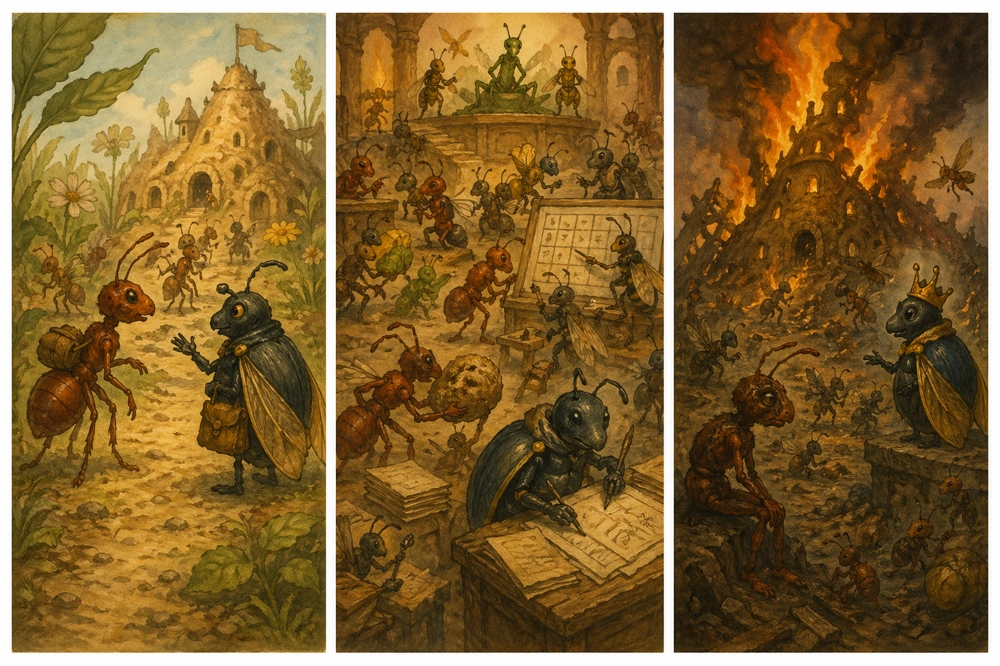
And that became the lesson told to young insects in the meadow: A colony that measures every insect’s ambition may forget to measure the colony’s survival. When work becomes a game of proving value instead of creating value, the best players rise, the best workers tire, and the fire reaches the walls while everyone is still completing the form.
Discussion
Replies are loaded from the public Mastodon thread for this article.
Loading replies from Mastodon...