The Gods Who Ranked Themselves
Posted on:
There is a myth that is no longer told, and that is the point of it.
It begins, as these stories do, on a mountain. At the top sat the gods, in a hall of white stone open to the sky, and below them, down the long green slope, lived the mortals who did the work of the world. The gods watched from above. The mortals labored below. Between them ran a single rule that everyone understood and no one said aloud: the gods were gods, and the mortals were not.
The gods were not cruel. They were warm, even. They laughed easily and remembered each other's names and spoke of the mortals below with a kind of fondness, the way one speaks fondly of a good harvest or a faithful dog.
They were simply certain. That was the whole of it. They were certain they belonged to the hall, and the others to the slope.
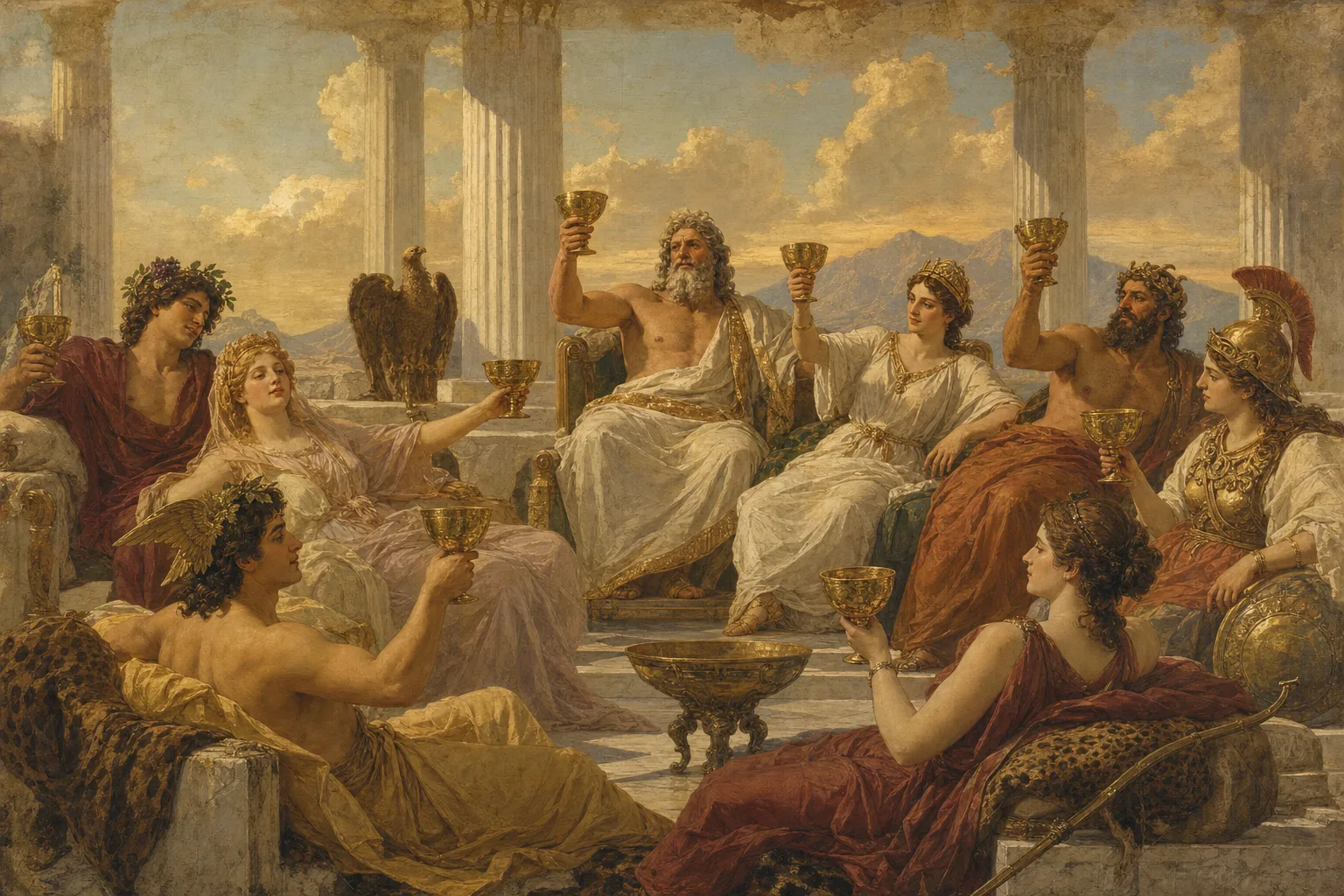
Among themselves, the gods kept a custom.
At the turning of the year they would gather in the hall, and over wine they would weigh one another. It was a gentle thing. One god would rise and speak of another, of his wisdom, his reach, the breadth of what he carried, and when he finished the hall would murmur its agreement, and the god who had been praised would rise in turn and praise the one beside him.
So it went around the circle. Each lifted the next, and the next lifted the one after, and by the end of the night every god in the hall sat a little higher than when the night began. No one was found wanting. No one was weighed and left lighter. The wine went around, and the praise went around, and the two were hard to tell apart.
“We are good,” they said to one another, and they believed it, because they had just heard it said.
It did not occur to them to ask who, in a circle where everyone lifts everyone, was ever truly measured. The question would have seemed strange. They were gods. The measuring was a celebration of a fact already settled. You do not test the sun to see whether it is bright.
And when the night was over they went out onto the terrace and looked down the slope at the mortals, and they felt the warmth of their own goodness still on them, and they said, “Now. What shall we do about the ones below?”
For the gods did not weigh the mortals the way they weighed themselves.
The mortals they weighed with great seriousness.
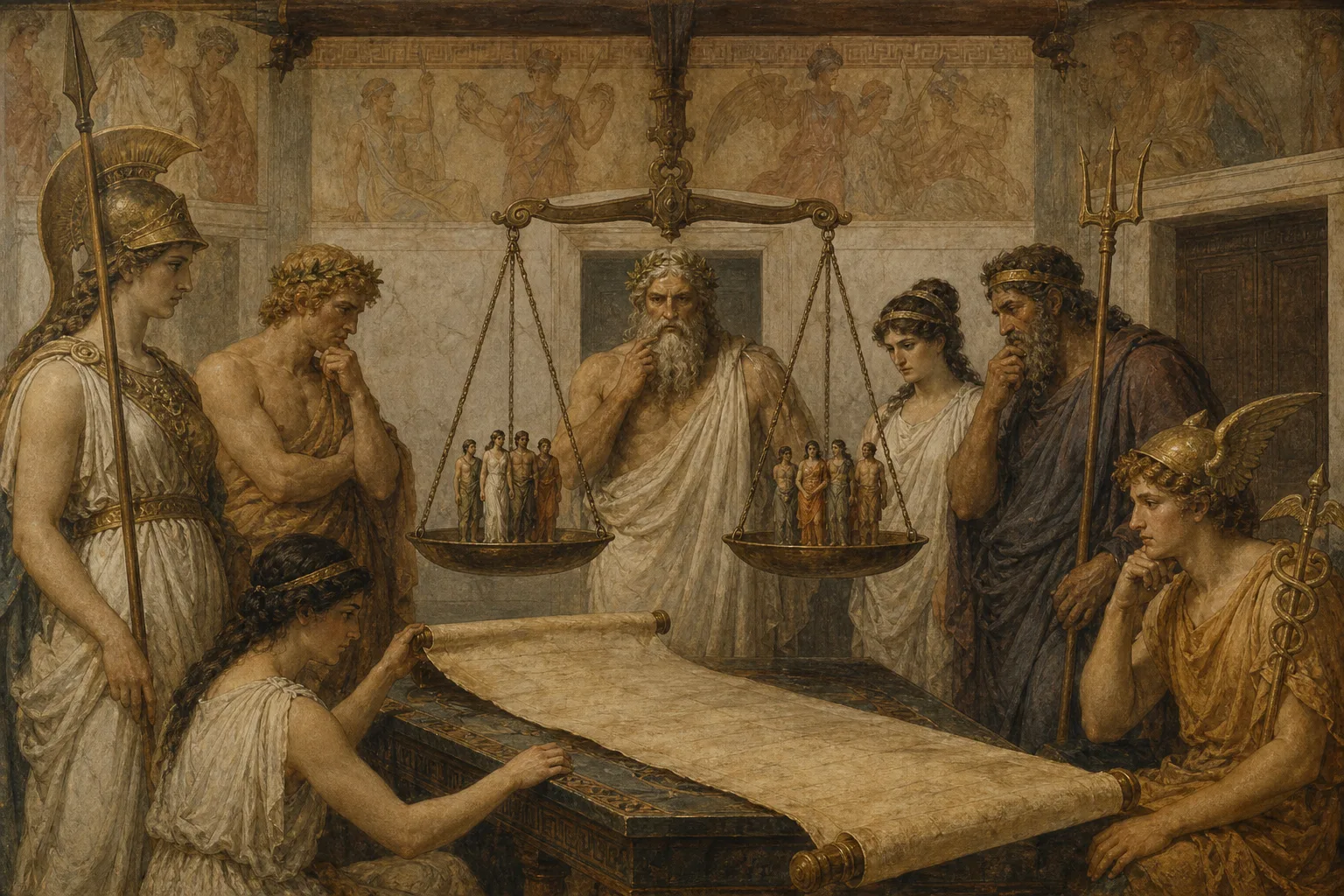
Four times a year the gods held a council, and the council was a solemn thing.
It was not done over wine. It was done in the long chamber behind the hall, with the doors shut, and it took the whole of a month and often more. The gods called it the Reckoning, and they prepared for it the way one prepares for a rite, because to them that is what it was.
They brought out the great scales, two pans of bronze hung from a beam, and beside the scales they set the ledger, a roll of vellum longer than a god is tall, on which every mortal's name was written. They appointed witnesses. They read aloud the old words at the opening, the vow each of them had spoken since the mountain was young.
“We come without favor,” the vow began. “We come to see clearly. We set down our own wishes at the door, that the scales may tell us what we did not already know.”
Then they would begin, and they would take up the mortals one by one.
They were careful. No one could say they were not careful. They spoke of each mortal at length, the work done and the work undone, the seasons strong and the seasons weak. They set one mortal against another and asked which had carried more, and they wrote their reasons in the ledger in a small and honest hand. They calibrated, they said. They removed bias, they said. They turned each name over in the light from many sides, so that no single side could deceive them. A god who judged too quickly was reminded, gently, of the vow.
It was, by any measure, a fair process. It had every part that a fair thing should have.
It was also, from the first word to the last, theater.
For every god in that chamber walked through the doors already knowing the name they had come to raise.
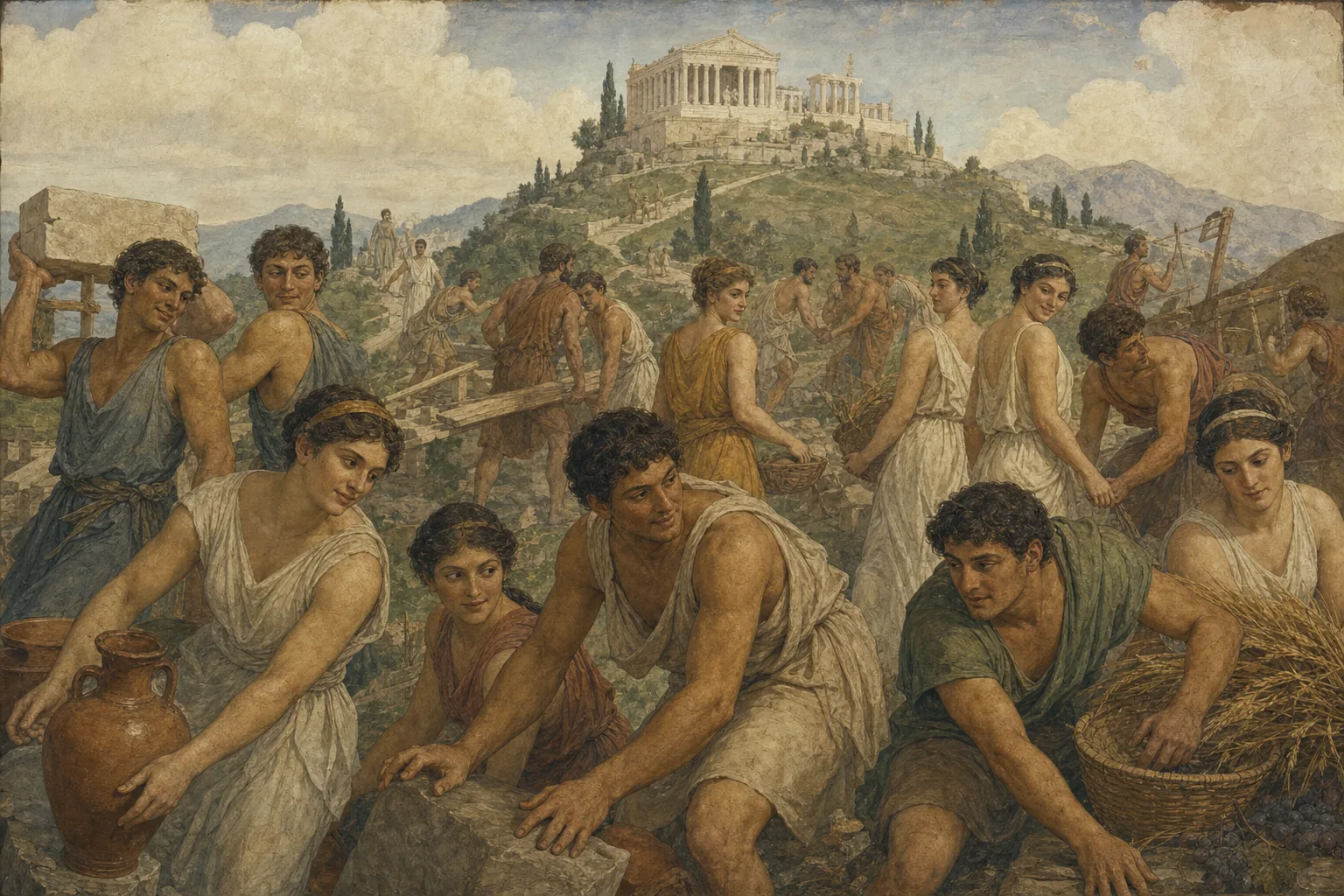
Each god had below him his own mortals, and among them one he favored, and the favorite had been chosen long before the council met, in the ordinary way that favorites are chosen, by being near, by being liked, by reminding the god a little of himself. The council did not discover the favorite. The council dressed him.
So when the scales were brought out, the god whose turn it was would speak, and the scales would tip, somehow, toward the one he had already chosen, and the reasons would be written down in the small honest hand, and the witnesses would nod, and the vow would hang in the air above all of it like incense. The other mortals on his list were spoken of with care and then set gently aside, and no one in the chamber could have told you the moment the decision was made, because the decision had been made in another room, on another day, by a god who was now performing his surprise.
When it was done, the gods felt clean. They had been thorough. They had been fair. They had set their wishes at the door, exactly as the vow required, and if their wishes had somehow walked back in and sat down beside them, well, no one had seen it happen, and so it had not happened.
They descended from the chamber tired and satisfied, the way you are tired after honest work, and they announced the risings to the slope below, and the slope received them as the verdict of the scales.
Down on the slope, the mortals worked.
They were told, and they mostly believed, that they were one thing. One chorus, the gods called them, raising one song to the hall. There was truth in it. The work was real and they did it together, and a mortal alone could no more have done it than a single voice could fill the sky. They leaned on each other. They covered each other's gaps. They meant it when they called each other friend.
But they also knew about the council.
They knew that four times a year the doors closed and the scales came out and the names were weighed, and that some names rose and most did not. They could not see into the chamber, but they could feel its eye on them all year long, the way you feel weather coming before you can name it.
And so beneath the one song ran another, quieter sound.
It was the sound of measuring. A mortal would help his friend and, helping, note how the help would look when the doors closed. He would praise his neighbor's work and, praising, weigh his own against it. They shared, and kept a little back. They smiled, and the smile had a ledger behind it. No one declared a war, and no one would have admitted to fighting one, and yet every day, under the chorus, a thousand small contests were lost and won.
They called each other friend, and they were friends, and they were also, quietly, each other's scale.
This was the shape of the mountain. Above, in the hall, the weighing was a toast, and everyone rose. Below, on the slope, the weighing was a war, and someone always fell. And the gods who ran both did not see that they were two different things, because to them it was obvious why. Up here were gods. Down there were mortals. The difference explained itself.
There was one god in the hall who was not certain.
He was a small god, and a young one as gods go. Iacchus, they called him, when they called him anything at all. He had come up from the slope himself in a year so distant that the others had stopped remembering it. He remembered it. He remembered the chorus and the quiet war beneath it, and the feeling of the council's eye, and the morning he had been raised and had walked up the slope into the hall and found, to his surprise, that nothing inside him had changed. He had felt no larger. He had only been told he was.
So at one turning of the year, when the praise was going around the circle and each god was lifting the next, Iacchus set down his cup and asked a question.
“Why,” he said, “do we weigh ourselves with wine and weigh them with bronze?”
The circle paused, more puzzled than offended.
“We weigh ourselves kindly,” he went on, “and find ourselves good, every year, without fail. And we weigh them carefully, with scales and witnesses and the vow, and yet we already know the answer before the doors are shut. We have built a fair and solemn thing to deliver a verdict we wrote in advance. Why is our own weighing a celebration and theirs a trial?”
A god across the circle laughed, not unkindly. “Because we are gods,” he said, “and they are not. The scales are for those whose place is in question. Ours is not in question. What would we even put in the pans?”
The others nodded, and Iacchus nodded too, because there was no arguing with a thing so obvious, and the praise went around again, and his question sank without a ripple. He picked up his cup. It was easier to pick up the cup.
But he had said the word place, and the word stayed in the air, because there was one among them who knew exactly what a place was worth.
His name was Lycaon.
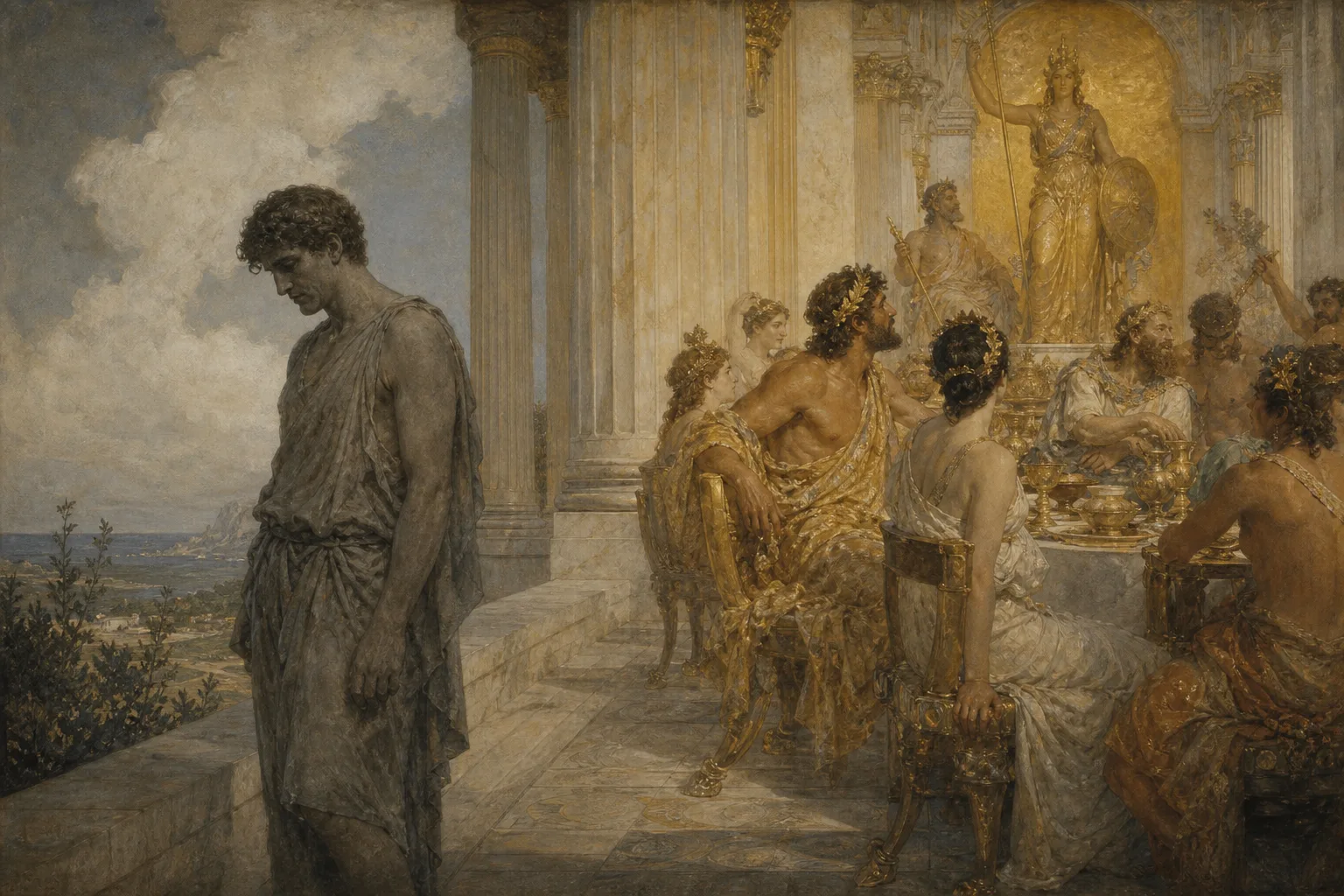
Once, Lycaon had sat high in the hall. Not at the rim but near the center, in a chair the others turned toward when they spoke. His name had been first in the ledger. When the praise went around at the turning of the year, the longest praise had been for him, and he had worn it the way they all wore it, as a fact about himself rather than a thing being handed to him.
Then he had fallen. The how of it does not matter, and that is part of the story too. A bad season, a wrong word, a shifting of favor among the others, the small ordinary weather by which the high are brought low. He was not cast out in thunder. He simply slid, over a year or two, from the center toward the rim, and from the rim toward the door, and one day he was no longer counted among the gods at all.
And here is the thing the myth was built to show.
When Lycaon was a god, he was a god in every eye. His words carried. His presence filled the chair. The others felt his weight when he entered a room.
When Lycaon fell, all of that left him in a single season, and not because anything inside him had changed. He was the same being he had always been, with the same thoughts and the same voice. But the chair was gone, and with the chair went the weight, and with the weight went the eyes.
The gods did not hate him. It was worse than that. They forgot him.
He would come up the slope sometimes and stand at the edge of the hall, and the gods would look past him as one looks past a servant or a stone. Not cruelly. Simply without seeing. To them he was no longer a god who had fallen. He was a mortal who had wandered too high, a plain man on the wrong terrace, and they could not quite remember that he had ever sat in the center, or that they had ever turned toward his chair, or that the longest praise had once been for him. It was not that they chose to forget. It was that, without the chair, there was nothing there to remember. The greatness had never been in Lycaon. It had been in the seat.
And Iacchus, watching Lycaon stand unseen at the edge of the hall, understood at last what he had been trying to ask.
The gods were not gods. They were mortals in chairs. The chair made the weight, and the weight made the eyes, and the eyes made the god, and take away the chair and you were left with a man on a slope, the same as any other, indistinguishable from the chorus below. There was no second kind of being on the mountain. There never had been. There was one kind of being, divided only by where they happened to be sitting, and the whole solemn machinery of the hall, the toast and the trial, the wine and the bronze, existed to hide that single fact from the ones it would have humbled.
He looked down the slope at the mortals weighing one another in their quiet war, each straining toward a chair, and he wanted to call down to them that the chair was empty, that it had always been empty, that there was no god at the top of the climb, only the climb. But he did not. It is hard to be heard from a hall, and harder still to say a thing that would unmake the room you are standing in.
So the mountain went on as it was.
The councils met, four times a year, solemn and fair and decided in advance. The praise went around the circle at the turning of each year, and the gods rose together and found themselves good. The mortals sang their one song and fought their thousand quiet contests beneath it. And now and then a god fell, and slid from the center to the door, and was forgotten in a season, and a new face took the chair and felt himself grow large in it, never guessing that the largeness was on loan.
And here is how the myth ends, which is why it is no longer told.
The gods, so busy being weighed kindly and weighing others hard, never noticed that they too were being measured, not by scales but by time. With each generation that passed below, the stories of the gods grew a little shorter. A name that had filled a verse now filled a line. A god who had been first in the ledger became a god who was merely mentioned, and then a god whose name you half-recalled, and then a blank where a name had been.
The hall did not fall. No one stormed it. The gods simply thinned out of the telling the way Lycaon had thinned out of the hall, quietly, without thunder, until one day a child on the slope asked who had lived at the top of the mountain, and no one could quite say. There had been someone up there once. Important, they thought. It was hard to remember why.
The chairs are still up there, they say, in the white hall open to the sky. Empty now. The scales have gone green. The long ledger has rotted to lace. And the slope below is full of people working, leaning on each other, covering each other's gaps, calling each other friend, and weighing each other still, all of them straining toward a hall where no one is left to be impressed.
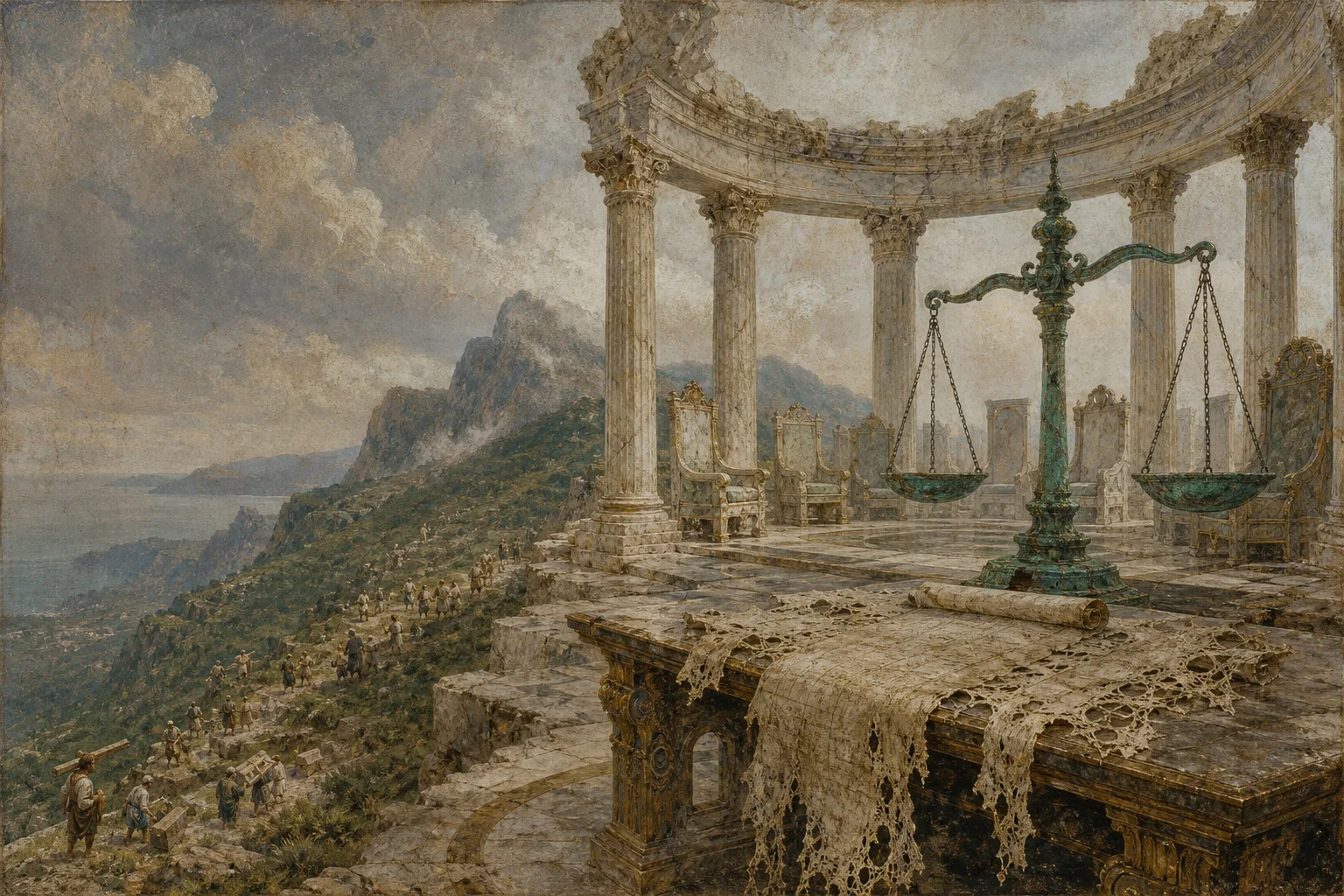
Moral: A weighing where everyone rises is not a measure but a mirror, and a fair process built to deliver a verdict already chosen is not fairness but a costume worn over a wish. The high are not a different kind of being; they are people in a chair, and the chair makes the weight, the way it made Lycaon's until he lost it and was forgotten in a season. No one likes to be ranked forever, because forever-ranking is the opposite of being seen, and in the end the rankers are ranked too, by time, which empties every chair and shortens every story until the gods are as forgotten as the man they walked past at the door. We were never two kinds. We were always one, doing our best on the same slope, and the only ones who escape the long forgetting are the ones who never needed the chair to know they were already enough.
Discussion
Replies are loaded from the public Mastodon thread for this article.
Loading replies from Mastodon...