The Hill That Was Not a Mountain
Posted on:
In a small valley between two quiet woods, there lived a colony of field mice.
They were good mice. Careful mice. Proud mice.
They gathered seeds, repaired tunnels, counted berries, and kept small maps of every path between the grass and the old stone wall.
One spring, the colony decided to build a new crossing over a shallow ditch.
The ditch was not wide. The water was not deep. The crossing would be used by a few hundred mice at most.
Still, it mattered.
A crossing would save time during rain. It would let the younger mice reach the berry patch without muddy paws. It would make life easier.
So the mice gathered to begin. But before the first twig was placed, a hawk circled high above. The hawk did not live in the valley. He did not cross the ditch. He did not gather seeds. But from the sky, he enjoyed giving instructions.
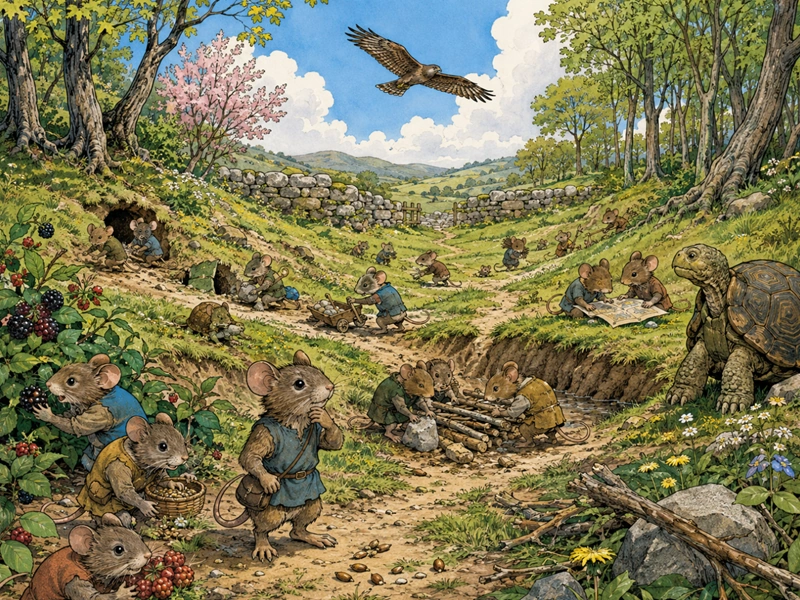
“This crossing must be perfect,” the hawk cried. “What if every creature in the forest uses it? What if a flood comes? What if a herd of deer runs across it? What if the wind turns against us?”
The mice looked at one another.
A young mouse named Tilo raised a paw. “Only our colony will use it,” he said. “And mostly during light rain.” The hawk narrowed his eyes. “That is small thinking.” The valley grew quiet. No mouse wished to be accused of small thinking.
So the plan changed.
The crossing would no longer be a simple path of stones and twigs. It would become a grand structure.
The mice measured the ditch again. Then again. Then again.
They debated the strength of every twig. They argued over the angle of every pebble. They worried whether the crossing could support ten mice, then one hundred, then ten thousand.
No one had ever seen ten thousand mice in the valley.
Still, the question remained in the air like a storm cloud.
“What if?”
Days passed.
The mice stopped sleeping well.
One mouse was blamed for choosing grass that bent too easily. Another was scolded for placing a stone too close to the mud. A third was told her knot might fail in weather no one had ever seen.
The crossing, still unfinished, became the most important thing in the world.
From the ground, it felt enormous.
Every twig seemed urgent. Every pebble became a risk. Every disagreement sounded like danger.
The hawk circled each morning.
“Faster,” he called. “Better. Think bigger.”
The mice worked harder.
They forgot the berry patch. They forgot the soft evenings. They forgot that the ditch was only a ditch.
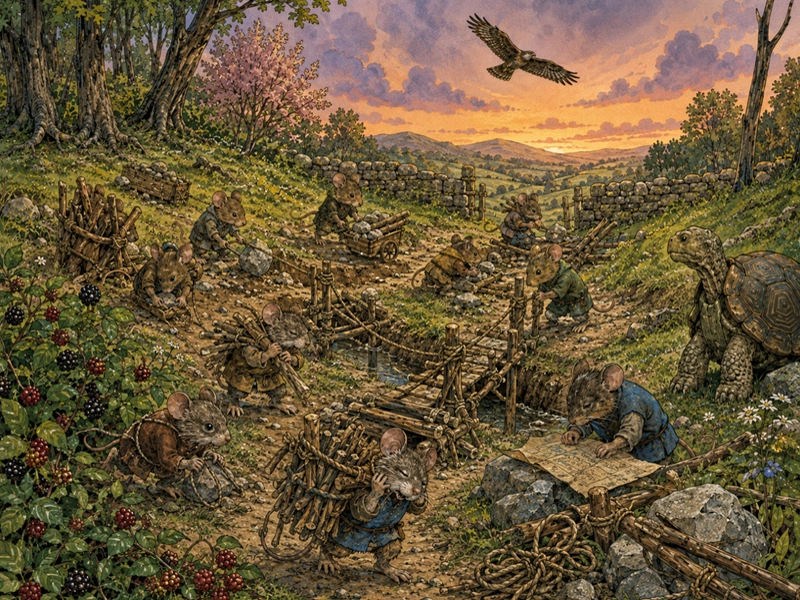
At the edge of the colony lived an old tortoise named Soren.
Soren moved slowly and spoke rarely. Most mice respected him, though few had patience for his pace.
One afternoon, while the colony argued over whether the crossing needed a second layer of bark, Soren climbed a nearby hill. It took him a long time. The mice barely noticed. From the hilltop, Soren looked down.
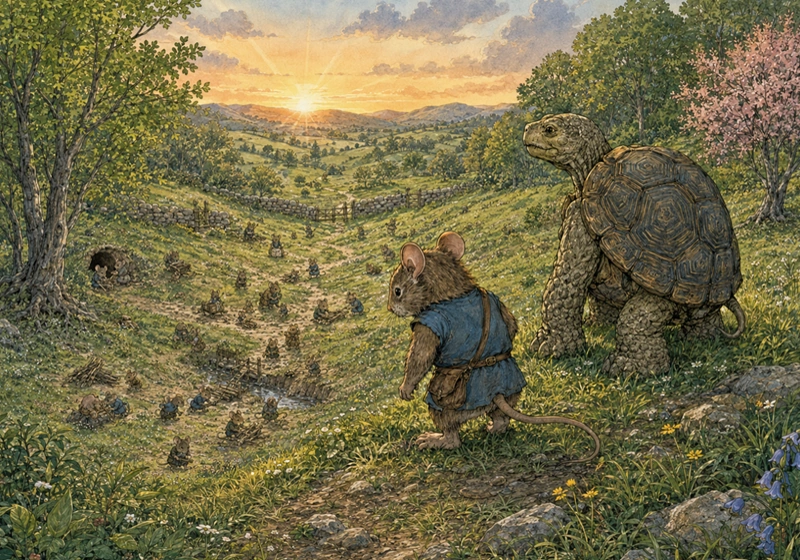
He saw the ditch. Thin as a thread. He saw the crossing. Half-built, but already enough for most days. He saw the berry patch, waiting. He saw the mice, exhausted and afraid. He saw the hawk, large in voice but far from the work.
After a while, Tilo climbed the hill too. He arrived breathless. “What do you see?” asked Soren.
Tilo looked down. At first, he saw the same worry. The crossing. The arguments. The unfinished knots. Then his eyes adjusted. The ditch looked smaller from above. The valley looked larger. The whole problem, which had filled his mind for weeks, now sat quietly between two patches of grass. Tilo said nothing.
Soren smiled gently. “From inside the ditch,” said the tortoise, “every shadow looks like a cliff.”
Tilo watched the colony below. “We treated it like a mountain,” he said. “It was a hill,” said Soren. “Perhaps not even that.” The next morning, Tilo returned to the mice.
He did not shout. He did not accuse. He simply said, “The crossing must be safe for mice. Not for imaginary deer.”
Some mice looked relieved. Others looked frightened.
The hawk, circling above, cried, “You lack ambition.” Tilo looked at the ditch, then at the tired faces around him.
“No,” he said. “I am trying to remember the purpose.” The mice finished the crossing in two days. It was not perfect. It did not survive imaginary floods. It did not carry imaginary herds. It did not impress the hawk.
But it carried the mice. They crossed it in the rain. They reached the berry patch. Their paws stayed clean enough. For a while, the hawk complained from above. He warned that disaster would come. He said the colony had settled for less.
But the seasons changed. No herd arrived. No thousand mice came marching. No great flood washed through the valley.
The crossing remained what it had always needed to be: useful.
Years later, some mice remembered the fear more than the bridge. They remembered how large the ditch had felt while they were standing inside it. They remembered how certain the hawk had sounded. They remembered how easily worry had dressed itself as wisdom.
Most forgot. A few did not. And when those few faced new troubles, they learned to climb the hill before naming the mountain.
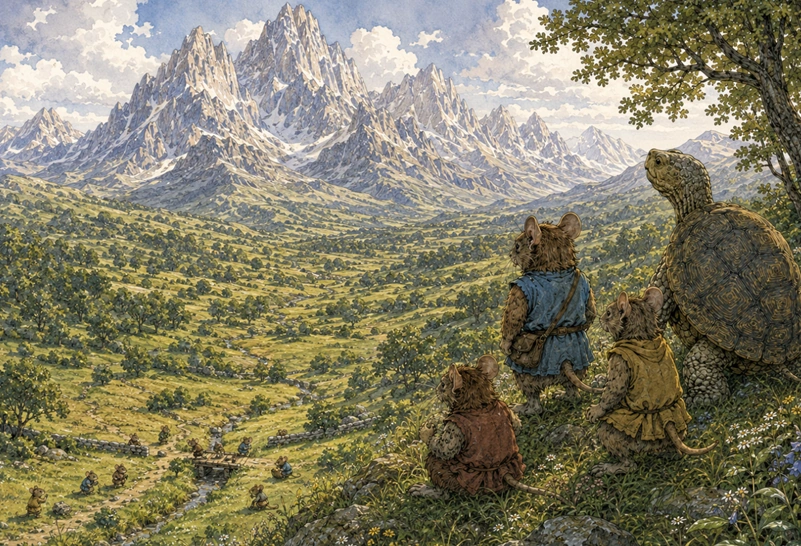
Moral: A problem seen too closely can grow larger than truth. Sometimes wisdom is not found by adding more fear, more process, or more urgency, but by stepping back far enough to remember what the work was actually for.
Discussion
Replies are loaded from the public Mastodon thread for this article.
Loading replies from Mastodon...