The Porcupine and the Mask on the Coat Rack
Posted on:
At the bottom of a quiet hill, in a small, warm burrow, lived a porcupine named Hollis. He had a partner who wore a flower behind her ear, two little ones who never walked when they could run, and a coat of quills that stood up whenever he laughed, which was often.
Beside the front door stood an old wooden coat rack. On its highest hook hung a mask.
It was a pale, smooth mask with polite eyebrows, rosy painted cheeks, and a smile that never got tired. Hollis had received it on his first day at the Great Burrow, where the important work of the valley was done. “Everyone wears one here,” the badger at the front desk had told him. “Nobody wants to see quills at a meeting.”
So every morning, Hollis took the mask from the coat rack, tied the red strings behind his ears, and went to work. At the Great Burrow, the mask nodded at the right moments. It agreed when agreeing was easier. It smiled at jokes that were not funny and at decisions that were not kind. It never bristled.
And every evening, Hollis came home, untied the strings, hung the mask back on its hook, and shook his quills loose. His little ones ran into his arms. His partner laughed at the stories he told about his day. The mask watched them from the coat rack, smiling at nothing.
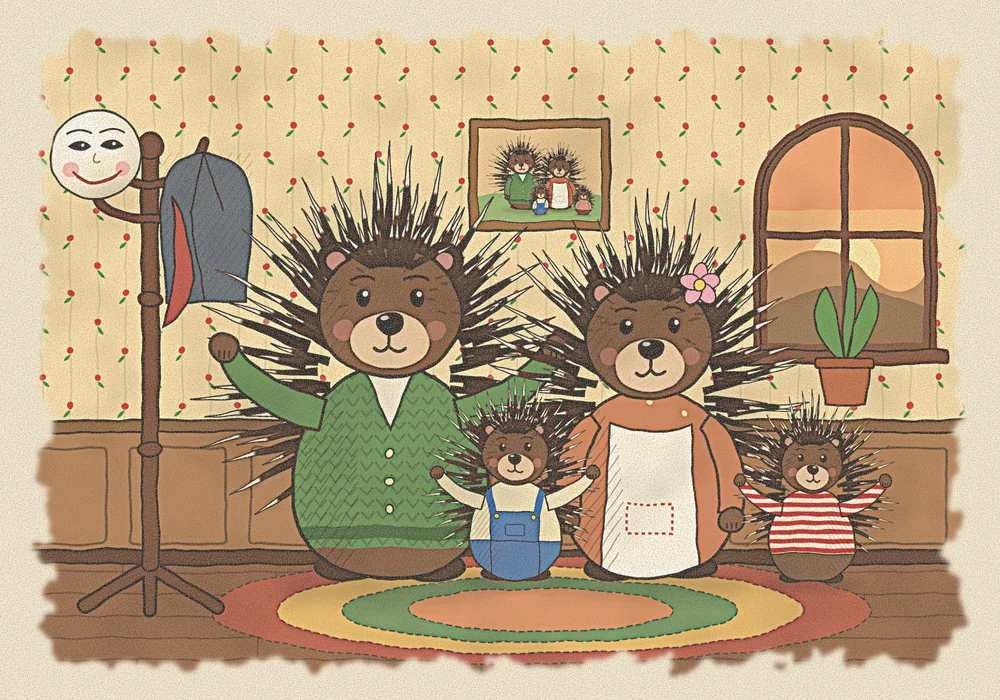
“It’s only for work,” Hollis would say. “It’s temporary. Just until things settle down.”
Things did not settle down.
The meetings grew longer. The badger asked for more smiles, more nods, and fewer questions. Hollis wore the mask a little earlier in the morning and took it off a little later at night. Some evenings he forgot it was on until his youngest asked why Papa was smiling at the soup.
Then, one night, the strings would not come loose. Hollis tugged at the edges. The mask held. Where the mask met his face, the fur had grown pale and smooth, as if the mask had been quietly reaching out while he was not looking. He pulled harder, and it hurt the way pulling out a part of yourself hurts.
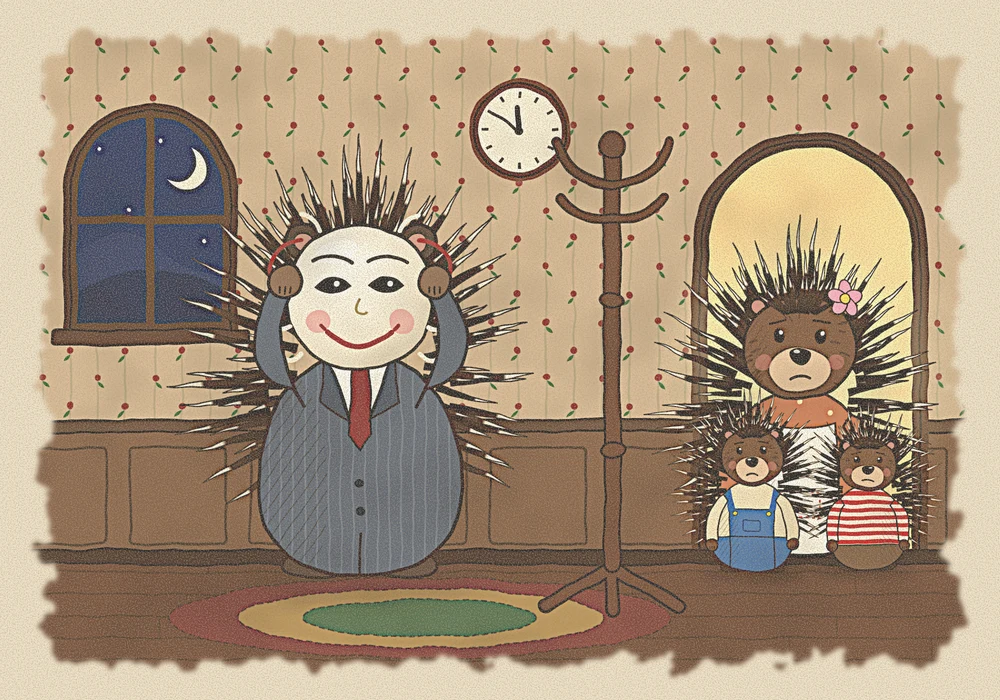
His family waited in the doorway. “Tomorrow,” Hollis said through the painted smile. “I’ll get it off tomorrow.”
But tomorrow he went to work wearing it, because it was already on. And the next day too. After a while, he stopped reaching for the strings. They had sunk into his fur, and then there were no strings at all. The mask was no longer something Hollis wore. It was simply Hollis’s face.
Nobody at the Great Burrow noticed. That was the point of the mask. At home, his little ones noticed, but children grow used to everything, and soon they stopped asking.
The pale smoothness did not stop at his face. It crept down his neck, across his shoulders, along his arms. One by one, his quills softened and fell away, and the skin beneath them was the same pale, polite color as the mask. He did not bristle anymore, not at work and not at home. There was no edge left to show where the mask ended and the porcupine began.
Then, one autumn, Hollis was given a new job. A bigger office. A bigger title. A new mask. This one was grey-blue and square, with narrow eyes, firm brows, and a straight mouth that never smiled. “Smiling is for your old team,” his new manager said. “Here, we need someone serious.” It waited for him on the coat rack, on the same hook as the first one.
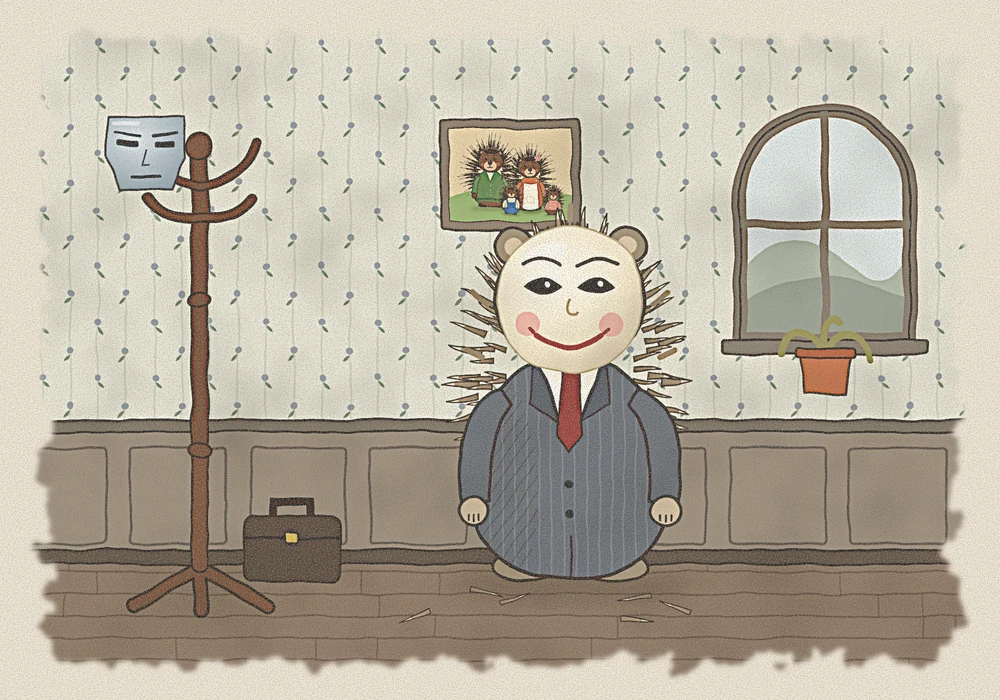
Hollis put it on over the face that had once been a mask. He did not have to tie it. It already knew where to go.
Years passed. Many of them. The little ones grew up and moved to their own burrows on other hills. The badger retired. New masks came and went on the coat rack, each one pressed over the one before.
One night, long after everyone was asleep, Hollis stood before the tall oval mirror in the hallway. He looked for a long time. A smooth, pale creature looked back at him, with no quills and a grey-blue face that did not move. Below its edge, at the corners of its mouth, he could just see the faded red of an old painted smile.
Tucked into the corner of the mirror was a photograph. In it, a porcupine with a full, wild coat of quills was laughing, his arms around a partner with a flower behind her ear, and two little ones tangled at his feet.
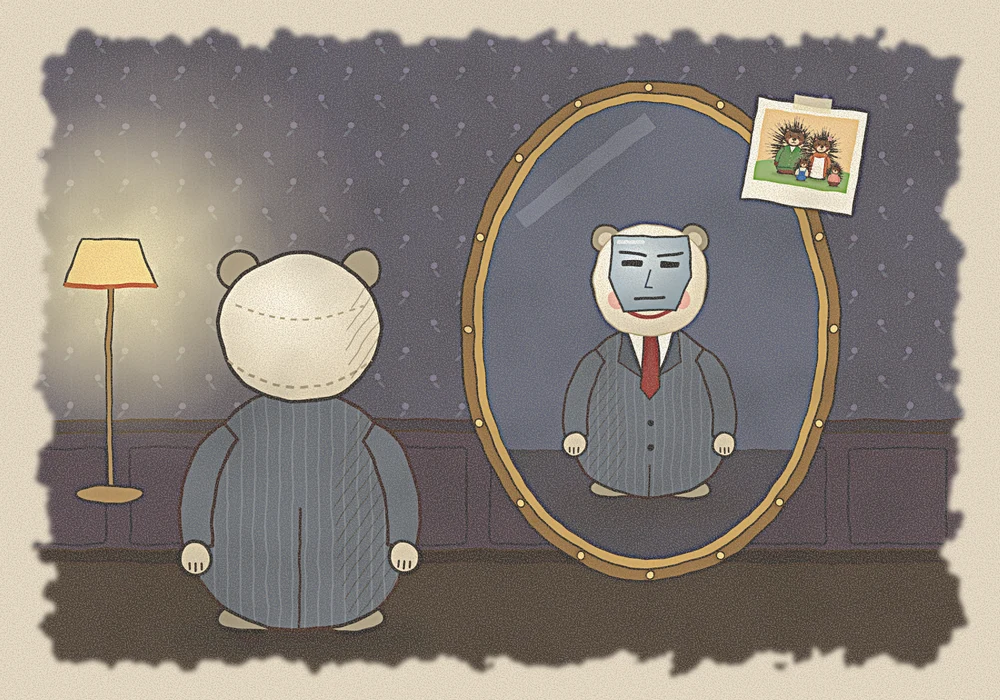
Hollis looked from the photograph to the mirror, and from the mirror to the photograph. He did not recognize either of them. The porcupine in the photograph was a stranger who had once lived in this burrow. The creature in the mirror was a stranger who lived there now. And somewhere between them, every morning had looked like a small decision that did not matter.
Moral: Kurt Vonnegut wrote, “We are what we pretend to be, so we must be careful about what we pretend to be.” Hollis never decided to become the mask. He only decided, one morning at a time, to wear it a little longer.
Carl Jung called that mask the persona: the face we build to meet the world, designed to make an impression on others and to conceal our true nature. Jung did not say we should throw it away. Every job, every role, every community asks for one, and wearing it is often reasonable. The danger, he warned, is that we “become identical with” our personas, “the professor with his text-book, the tenor with his voice.”
A mask is a tool only as long as you can still take it off. So hang it back on the coat rack every evening, even when it is tired and stuck and easier to leave on. Notice where it is starting to grip. And check from time to time that the face in the mirror is still one you recognize.
Discussion
Replies are loaded from the public Mastodon thread for this article.
Loading replies from Mastodon...