The Rhinoceros and the Shiny River
Posted on:
In a vast savanna stood a prosperous village built by many animals over many seasons. Beavers maintained the waterways, ants organized supplies, owls studied the stars, and elephants remembered the lessons of years past. One day, a rhinoceros arrived to lead part of the village. The rhinoceros was strong, confident, and impossible to ignore. Wherever he walked, dust rose behind him. Whenever he spoke, he spoke loudly.
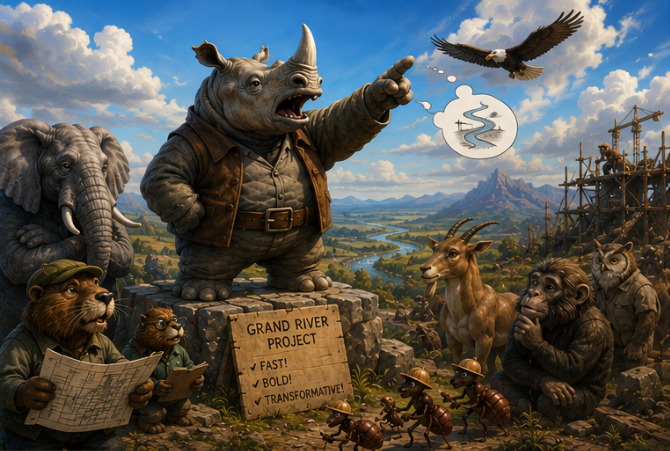
At first, many animals admired him. “He acts with conviction,” said the gazelles. “He gets things done,” said the monkeys. And indeed, the rhinoceros was always busy.
One morning, an eagle from the distant mountains flew overhead and casually remarked, “I wonder what could be accomplished if water flowed through the eastern plains.” The comment was forgotten by most animals before sunset. But not by the rhinoceros.
The next day he charged into the village square. “We shall build a grand river through the eastern plains!” he declared. The beavers explained that no one needed such a river. The ants pointed out that many important repairs were unfinished. The elephants recalled that previous villages had tried similar projects and abandoned them.
But the rhinoceros had already decided. “The eagle mentioned it,” he said. “Clearly this is the future.” And so every animal was redirected toward the new effort. The rhinoceros designed the river according to his own preferences. He dismissed concerns, ignored experience, and demanded speed above all else. “Move faster.” “Question less.” “Trust the vision.” Those became his favorite phrases.
Months later, the river was complete. The rhinoceros proudly led executives from distant lands to admire it. For a brief moment, the river sparkled in the sunlight. Visitors praised the initiative. The rhinoceros received congratulations and attention.
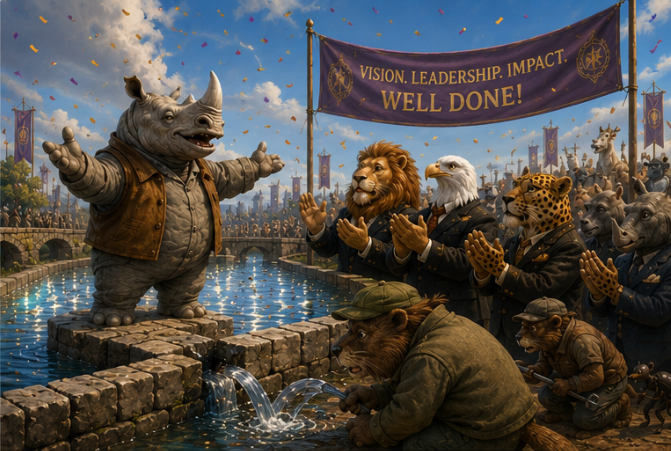
Then the eagle flew elsewhere. The conversations changed. The spotlight moved on. Immediately, the rhinoceros lost interest.
The river leaked into fields that did not need water. Maintenance was difficult. Several animals who had warned of problems were now tasked with fixing them. When asked how the river should be maintained, the rhinoceros replied: “That is now the responsibility of the village.” When asked why the design ignored earlier advice, he replied: “The important thing is that we moved quickly.” When asked who should address the growing problems, he replied: “The teams must learn ownership.” And with that, he turned his attention elsewhere.
Soon another passing executive mentioned floating gardens. The rhinoceros abandoned the river and charged toward a new idea. The cycle repeated. Each season produced a new initiative. Each initiative was urgent. Each initiative was declared transformational. Each initiative became someone else's responsibility once the attention faded. Over time, the village became littered with unfinished canals, half-built gardens, abandoned towers, and countless projects nobody truly wanted but everyone was forced to maintain.
The rhinoceros, however, remained pleased with himself. He measured success not by what endured, but by how often he was seen leading. One day, an even larger savanna offered him a more prestigious title. Without hesitation, he accepted.
The rhinoceros departed, leaving behind a tangled landscape of neglected projects and exhausted animals. As he disappeared over the horizon, the beavers began repairing broken waterways. The ants reorganized scattered resources. The elephants documented what had gone wrong so future generations might avoid repeating it.
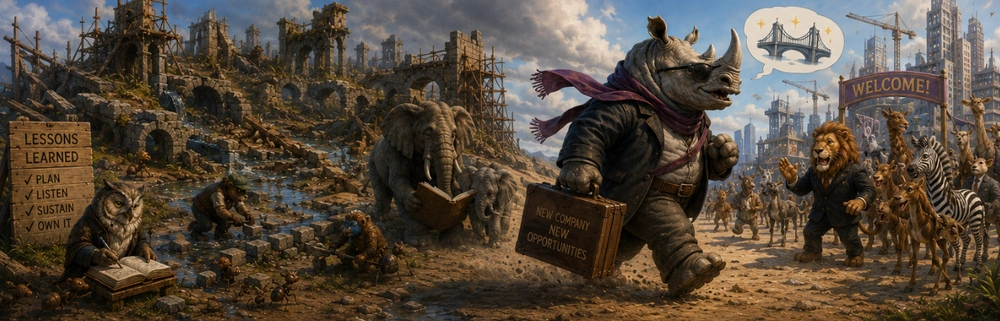
Meanwhile, in the distant savanna, the rhinoceros arrived to great fanfare. During his first week, he overheard a lion casually wonder whether villages should build crystal bridges. The rhinoceros' eyes widened. He immediately gathered the animals. “A magnificent opportunity awaits us,” he announced. And once again, dust rose behind him as he charged toward the next shiny idea.
Moral
Success is not measured by the number of initiatives one begins, but by the responsibility one accepts for what remains after the excitement has passed.
Discussion
Replies are loaded from the public Mastodon thread for this article.
Loading replies from Mastodon...